
This post may contain affiliate links. Please read our disclosure.
If you’re physically active, sweat a lot, or your skin doesn’t take well to the adhesive in your continuous glucose monitor (CGM), you know you’re at risk for the CGM tape peeling off and detaching the sensor.
This has been a big problem for me in the past. Not only do I live in Miami (summer year round), but I’m also very active and the CGM tape on my Dexcom G7 just can’t keep up with my lifestyle.
Also, using the Dexcom G7 overlay tape causes my skin to break out in hives.
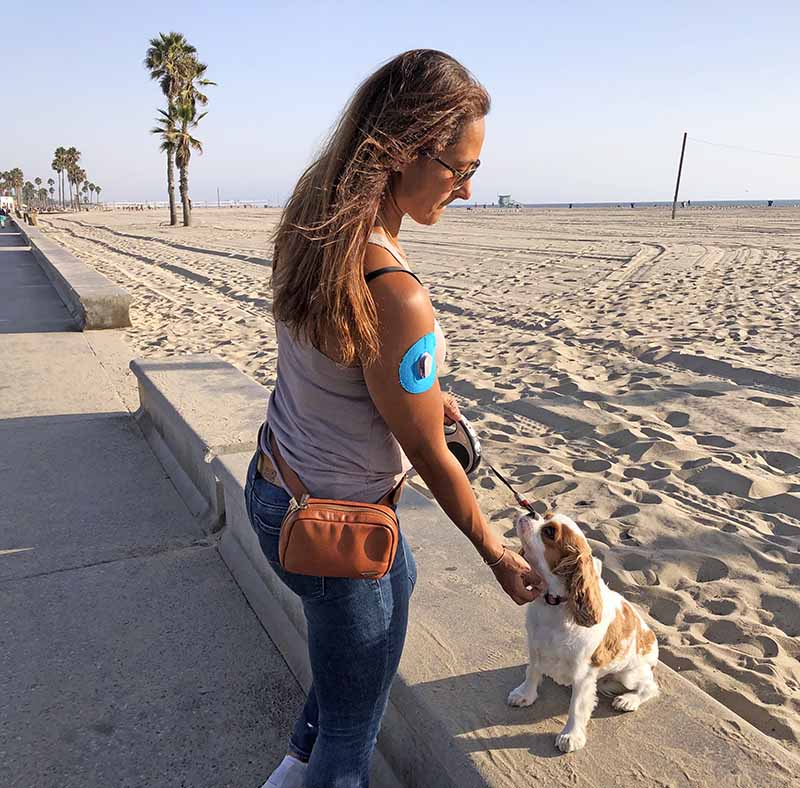
My solution is to add a soft cloth patch over the sensor to extend its lifespan, keep it from falling off, and prevent skin reactions.
But not all patches are created equal. In this post, we’ll explain why. skin grip This is my favorite patch.
This post is sponsored by Skin Grip, but the opinions are my own and I used the Skin Grip patch prior to being sponsored.
What to look for in a CGM patch
When it comes to CGM patches, the most important factors to me are:
- comfortable
- Ease of use
- affordable price
- design
patch comfort
I have very sensitive skin and most patches, including the Dexcom G7 Overlay Tape, leave my skin red and itchy.
That’s why I’m always looking for patches that allow my skin to breathe. However, look for an adhesive that is strong enough to keep the patch on for at least 10 days, but not so strong that it peels off your skin when you remove the patch.
There are many options available, and patches are usually one of the following:
- material like paper or plastic
- Cloth materials (skin grips, etc.)
I found that the paper-like material is very hard so it doesn’t stick to the skin easily and starts to peel off within a few days.
The plastic, on the other hand, stays on for a long time, and my skin clearly doesn’t like it and gets red and irritated within the first day.
As such, I tend to gravitate toward the fabric patches that Skin Grip offers.
Some people suggest just adding skin tack glue (additional body adhesive) under the other patches for better adhesion. That may be possible, but why not choose one that feels comfortable to stick on its own?
I sometimes use adhesive remover. Uni-Solve Adhesive Remover Wipes easily remove patches and residual adhesive after your Dexcom G7 lasts for 10 days.
The adhesive of the patch is very high, so you can easily remove the patch (especially if you apply the patch to an area with body hair).

Patch ease of use
It’s clear that you don’t need an advanced degree to apply a CGM patch, but if you have 10 thumbs like I do, or if you want to apply the patch in a hard-to-reach place (like the back of your arm), it can be a little difficult.
Depending on the patch, it may be very difficult to remove the patch from the paper that protects the adhesive. Some patches, such as the included Dexcom G7 overlay tape, may require you to remove the entire paper before applying it to your skin.
The problem with peeling off all the paper is that you’ll end up with a floppy, super sticky patch that will most likely just stick the patch itself (yes, I’ve done that many times).
my favorite place skin grip The paper peels off in four to five pieces, so you can choose to remove one piece or none at all before applying the patch to your skin.
I like to place it over the sensor, then remove one section, press down on the skin to make sure it sticks, and then move on to the other section. It works like a charm and I have yet to have to throw out a single patch because it stuck.
This method also means it can be applied with one hand without the need for assistance. So I don’t have to ask my husband for help every time I change a patch, and I can wear the sensor on my arm.
This video shows you how to install a skin grip on your Dexcom G6.
affordable prices for patches
Let’s be honest, living with diabetes is very expensive in most countries, so you can’t afford to spend a fortune on a CGM patch.
I’ve tried other patches with intricate designs, and while they’re fun, I don’t want to spend $3-4 per patch on a regular basis.
Packs of Skin Grip Patches range from $24.99 to $29.99 and include 20 disposable patches. This is only $1.25 to $1.50 per patch, which is very affordable compared to other patches currently available on the market.
Skin Grip has also released some special edition patches (see Classic Collection). These are a bit pricey at $24.99 for 10 patches.
Get 10% off using code DIABETESSTRONG on the Skin Grip website.

design
The last thing I consider when it comes to patches is design. This includes how it is cut and how it looks.
For the Dexcom G7, I prefer overlay tape without cutouts for the transmitter. Skin Grip provides just that. Does not degrade the sensor signal and fully protects the sensor.
I also like the bright colors. I can’t remember the last time I bought a “tan” overlay tape. If you want to experiment with different colors, there’s a “Rainbow” pack with 10 fun colors.
Where can I get skin grips
Skin grips can be purchased below. skin grip website or Amazon. We offer patches for Dexcom G6 and G7, Medtronic Guardian and Enlite, Abbott Freestyle Libre 2 and 3, Insulet OnmiPod, and infusion sets.
Get 10% off using code DIABETESSTRONG on the Skin Grib website.