Jumping (and learning how to jump higher) isn’t just a skill possessed by professional basketball players or high jumpers. Jumping is a fundamental human movement, like running, crouching, skipping, and throwing, explains CSCS’s Jack Coxall.
“Being able to jump, and being able to jump correctly, is not only a good skill, but it has a lot of transferability to other things,” Coxall says. “This includes power development and strength development, which decrease with age, force absorption, coordination, and increased bone density, which are associated with injury prevention.”
In other words, the time you spend learning how to jump higher is time well spent.
10 exercises to jump higher
“Jumping is clearly a lower body-based exercise,” Coxall explains. “Getting up into the air requires the power to exert force in your quadriceps, hamstrings, glutes, gastrocnemius, and soleus muscles. But jumping is not limited to this. Your core plays a key role in stabilizing your core during takeoff and landing. You need your arm muscles for balance.”
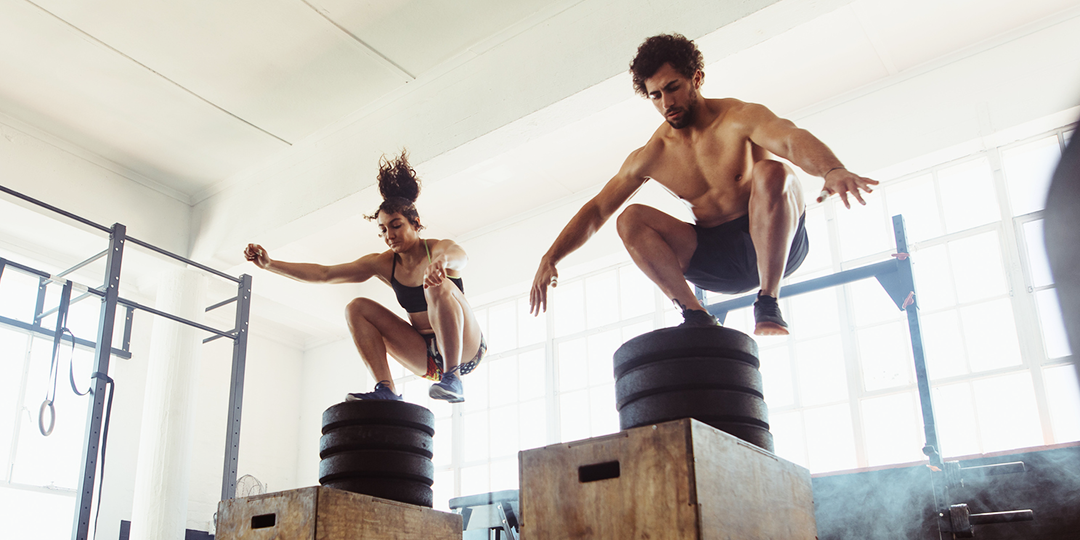
Training to jump higher should include plyometric movements like tuck-ups and box jumps, as well as strength-building movements like deadlifts and squats. “Increasing power in an exercise is not limited to just doing that exercise; other power movements such as slams, throws, and other types of jumps all benefit vertical jumps,” Coxall says.
Ready to jump higher? Try incorporating some of the following exercises into your workout routine.
1.Tuck up
- Stand with your feet hip-width apart and raise your fully extended arms, palms down, to chest height.
- Bend your knees and do a quarter squat, then press through the balls of your feet and jump straight into the air.
- When jumping, pull your knees up toward your chest. Try touching your knees to your palms.
- Land gently with your feet hip-width apart and your knees slightly bent.
2. Frog Jump
- Stand with your feet slightly wider than your shoulders and your feet facing outward.
- Keeping your chest up and hips flat, push your hips back and squat as low as possible, touching the floor between your feet with your fingertips if possible.
- Swing your arms forward and upward as you jump as high as you can.
- Land gently and immediately return to the squat to begin your next rep.
3. Alternate step jump
- Stand tall with your arms by your sides and your left foot on a bench with your hips, knees, and ankles all bent at 90 degrees.
- Keeping your chest up, shoulders back, and core engaged, swing your arms up and step through your left leg as you push yourself up with enough force to lift your left leg off the bench.
- Switch feet in the air, landing your right foot on the bench and your left foot on the floor. Continue alternating legs for each rep.
4. Holmsen Screamer Lunge
- Return to reverse lunge with your right foot, toes pointing forward, left foot flat, and the ball of your right foot on the floor. The right arm should be in front and the left arm behind. This is the starting position.
- Explosively raise your right knee forward and jump into the air as high as possible. At the same time, keep your left leg straight and switch arm positions so that your left arm is in front of you.
- Land gently on your left foot and return to your starting position.
- Repeat the same number of times on both sides.
5. Box jump
- Stand with your feet hip-width apart facing a stable, high surface such as a box. Bend your knees into a quarter squat and place your arms behind your back.
- Swing your arms out in front of you and jump up onto the box, bending your knees and landing with your feet flat on the box.
- Stand up and step off the box one foot at a time.
6. Weighted jump squat
- Stand tall with your feet shoulder-width apart, holding a dumbbell in both hands in front of your chest.
- Keeping your chest up and core engaged, push your hips back and lower your body until your thighs are parallel to the floor.
- Explosively stand up and jump straight up.
- Land gently with your knees bent to avoid landing flat-footed, then immediately lower your body into the next rep.
7. Dumbbell squats
- Stand with your feet hip-to-shoulder width apart and hold a dumbbell by your side at arm’s length.
- Keeping your back flat and core engaged, push your hips back, bend your knees, and lower your body until your thighs are parallel to the floor.
- Pause, then push your body up to the starting position.
8. Dumbbell push press
- Stand tall with your feet hip-to-shoulder width apart, dumbbells next to your shoulders, palms inward, and elbows close to your body.
- With your back flat and core engaged, push your hips back and bend your knees to get into a quarter squat position.
- Press the weight directly above your shoulders and push up explosively with your legs. Bring your biceps close to your ears.
- Lower the weight back to the starting position and repeat.
9. Romanian Deadlift
- Stand with your feet shoulder-width apart and parallel, holding dumbbells in front of your thighs, palms facing you.
- Pull your shoulders back, unlock your knees, and slowly bend your hips as you tighten your core and push your butt back into the wall behind you.
- Lower the weight until your torso is almost parallel to the floor, maintaining the natural arch in your lower back. Keep your head neutral and the weights close to your body during the movement.
- If you can’t go any further without arching your back (you should feel a deep stretch in your hamstrings), pause, squeeze your glutes at the top, and push your hips forward to return to the starting position.
10. Wall ball exercise
- Stand about 2 feet away from a wall with your feet hip-width apart. Place the wall ball between your hands at chest height. Tuck your elbows into your sides.
- Squat down, maintaining a neutral arch in your spine. Keep the ball close to your chest while you are down.
- Push your body off the floor, keeping your chest up, and throw the ball toward the wall above your head, aiming about 8 feet from the ground.
- Catch the ball after it touches the wall and return to the next squat.
- Repeat the exercise.
More tips to improve athletic performance
Higher vertical jumps lead to other health and fitness-related benefits, but it’s only one piece of the puzzle. If you want to improve your overall athletic performance, it’s important to approach your training from a holistic perspective.
1. Be careful about how you eat.
Most people know to avoid junk food in favor of healthy foods, but the timing of your nutrition is also important. After your workout, aim to consume 20 to 30 grams of protein within a few hours of your workout to help repair and rebuild your body’s muscle tissue.
2. Prioritize sleep
Adequate sleep (7-9 hours for adults) is critical to everyone’s physical and mental health, but for athletes it can be a literal game-changer. The National Hockey League, Major League Baseball and the National Basketball Association have all introduced policy changes that give players more time to rest and recover between games.
3. Stretching and Mobilization
As if you needed another reason to increase your mobility, there’s some evidence that stretching, especially dynamic stretching, can improve vertical jump performance. Now let’s shake a leg!