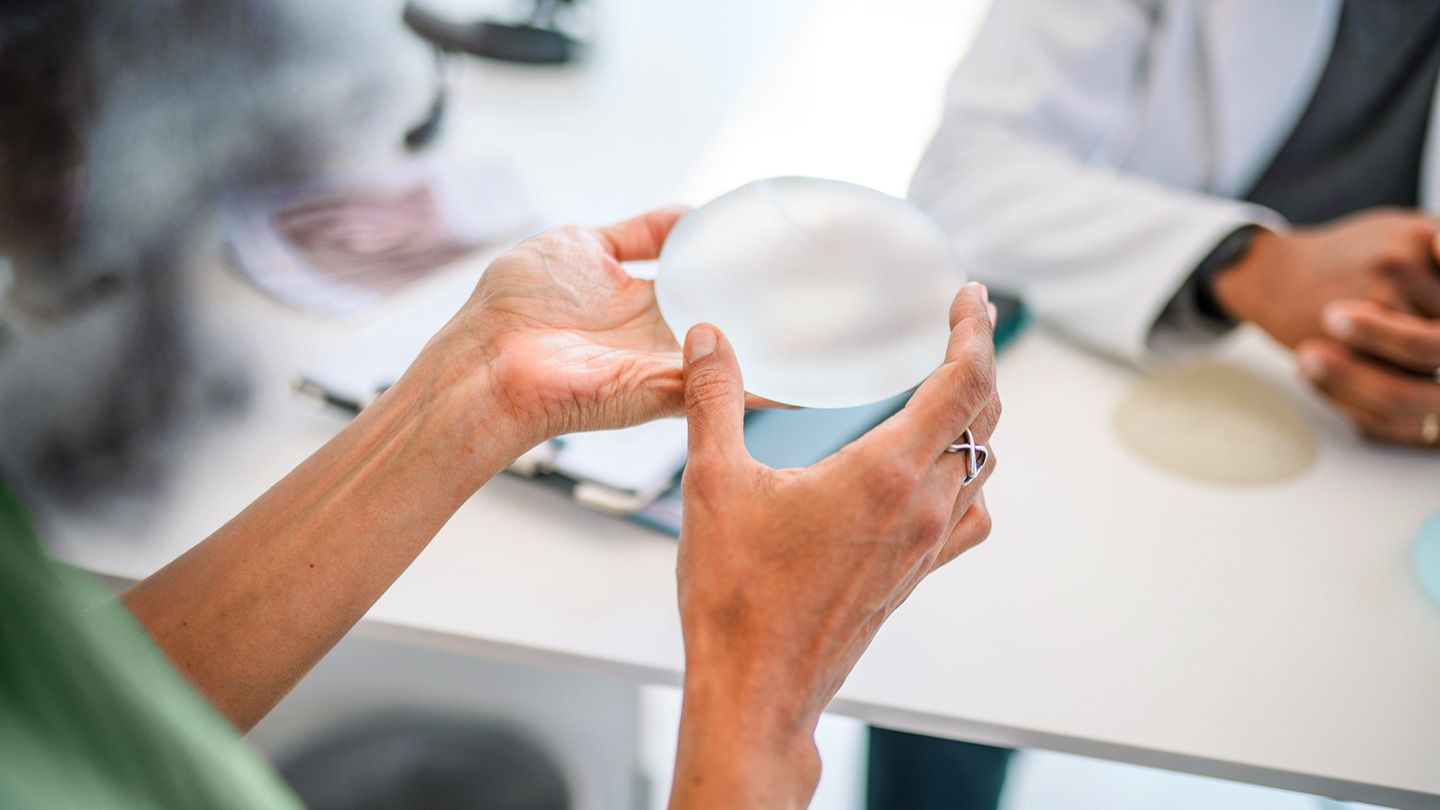
To reconstruct the breast mound after mastectomy, doctors choose either implant reconstruction or tissue (flap) reconstruction. Which of these surgeries you and your doctor choose will depend on your body type, breast size, and preferences.
implant reconstruction
Implant reconstruction can also be done at the same time as a mastectomy (called direct-to-implant), but this may not be the ideal method. “The revision rate (additional surgery later) with direct-to-implant is higher than with two-stage surgery,” Butler says. That’s because the skin over the breast can be stressed or damaged during a mastectomy. “Then placing a large implant in that skin pocket puts additional stress on the skin and can lead to complications such as implant extrusion (when the implant breaks through the skin) and infection.”
Instead, this procedure is usually done in stages. First, the surgeon places a tissue expander under the skin during the mastectomy. “We then inflate the tissue expander in the same way you would inflate a balloon in the office every few weeks until the appropriate size is reached. Once the patient reaches the appropriate size, we take the patient back for a minor outpatient procedure, where we remove the tissue expander and place the implant,” says Lyle Leipziger, M.D., chief plastic surgeon at North Shore University Hospital and Long Island Jewish Medical Center in New York.
flap reconstruction
Flap reconstruction uses your own tissue to reconstruct the breast. It is often performed at the same time as a mastectomy. The surgeon removes a section of tissue from the abdomen, back, buttocks, or thigh that has blood vessels attached and connects it to blood vessels in the chest for blood supply.
One of the benefits of flap reconstruction is that it uses your own tissue instead of a foreign implant. “A second, smaller surgery is usually required to adjust the tissue and reshape the breast,” Dr. Colwell says.
Nipple and areola reconstruction
In most cases, a mastectomy allows the surgeon to preserve the skin of the breast and remove only the underlying tissue. “In many cases, it is also possible to preserve the nipple of the breast with a nipple-sparing mastectomy,” Colwell says.
For people who have not had a nipple-sparing mastectomy, the final step in the reconstruction process is to reconstruct the nipple and areola (the colored ring of skin around the nipple). “We create a nipple by creating a small flap of tissue and rotating, twisting, and lifting it to give it a protrusion and roundness,” says Dr. Leipziger.
Years ago, plastic surgeons used skin grafts to recreate areolas. Now, they typically use 3D tattoos, which look so realistic that it’s hard to tell them apart from real nipples or areolas, Leipziger says.