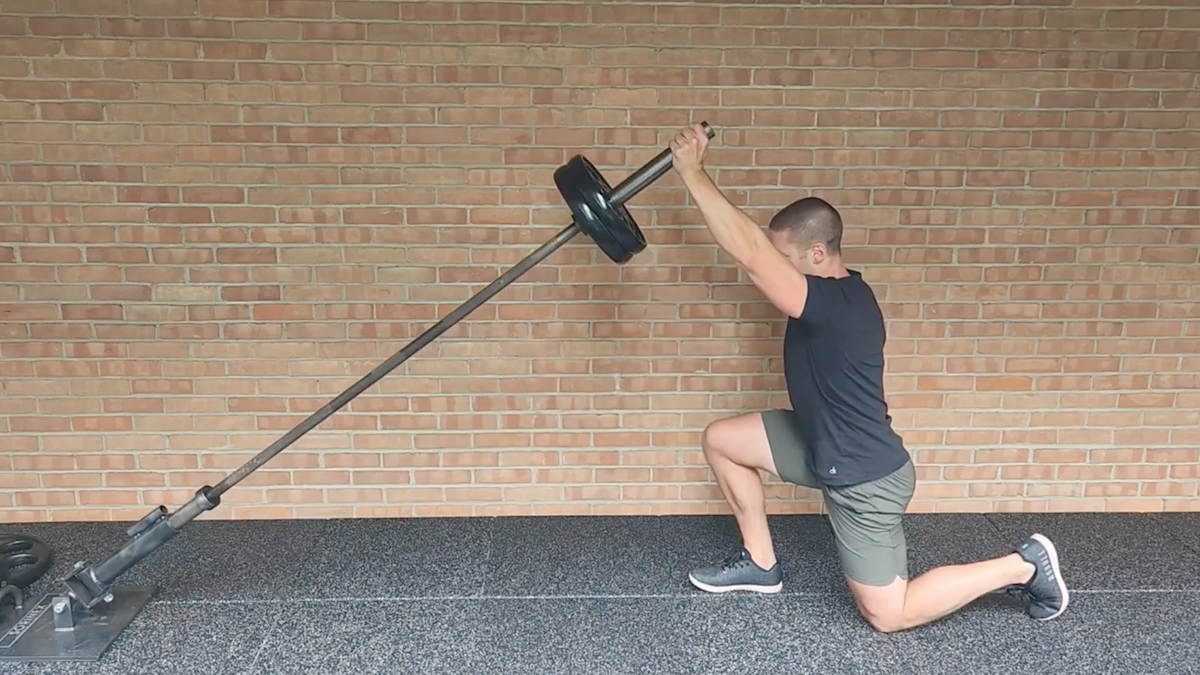
Mine uses a simple barbell and produces extraordinary results. Here’s how to use it:
You’ve probably seen lifters pushing, twisting, and counter-rotating the barbell while rowing. These aptly named landmine exercises produce lethally effective training. Mine training takes place in a variety of settings, from Division I college weight rooms to bodybuilding gyms to injury rehabilitation clinics.
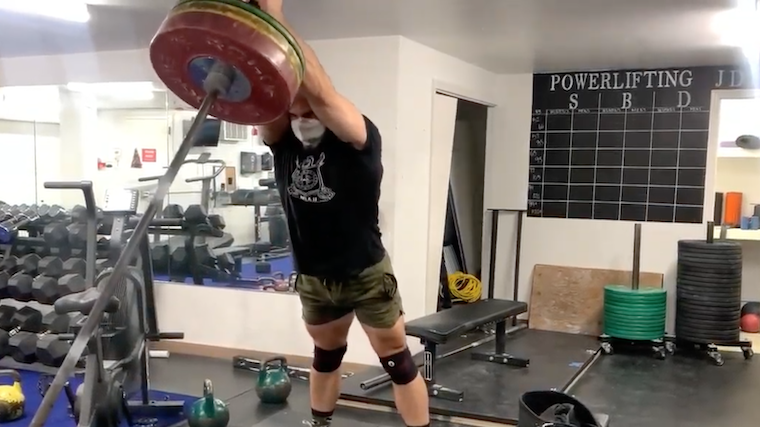
Barbells are used for lever-based resistance. As the lifter moves the loaded end through the space, one end pivots on the floor or in a special sleeve. Don’t get me wrong, this is not a workout for the fancy ‘gram or a serious misuse of equipment.
Mines provide an exercise opportunity with different characteristics than traditional free weight training. The best part? Landmine offers the versatility to train your entire body along with multiple elements of fitness. Here are the best landmine workouts and elite-level conditioning to build serious upper and lower body muscles.
best mine training
Benefits of mine training
Landmine training (literally) utilizes simple equipment to perform a wide range of exercises. Traditional barbell training is already so versatile, so why use a barbell as a minefield?
Mines provide a more predictable bar trajectory than a barbell that moves freely through space. In motor learning (the scientific field that studies movement and skill acquisition), this predictable bar path represents a “constraint.” This means that the mine is restricted to moving along an arcuate path.
This constraint helps lifters master form for technical multi-joint lifts such as presses, rows, and cleans used in the training below. We will also promote Consistent operating performance. Performing constant movements under load stimulates the targeted muscles very effectively. The result is fast learning curve Predictable increase in strength and size.
The arc-shaped bar path also changes your exercise form compared to barbell training. The landmine press prevents the shoulders from flexing through their final range, which is a commonly restricted area. The mine row promotes ideal movement of the scapula “down and behind”. Landmine squats virtually guarantee that your core stays upright and your hips stay tight, which requires textbook form.
Landmine exercises seem to place different stresses on your joints than traditional free weight lifting. (1) Overall, landmines may be: Helpful if you have strong knees or shoulders. Set up your mine and get ready to take your barbell training from a different angle.
the best Mine training to strengthen upper body muscles
The upper body mine workout below is like a kaiseki meal, a feast for the muscles. Meat and potatoes is a compound exercise followed by a solo exercise.
Compound exercises, or exercises that use multiple joints, are efficient This is because you train many muscle groups at the same time. They are also very effective They are great for building strength because they allow you to move heavier loads than exercises that train a single joint in isolation.
Compound exercises for the upper body can be broadly divided into “push” and “pull”. Pushing exercises involve pushing resistance away from your body and training your chest, shoulders, and triceps. In pulling exercises, you pull resistance toward your body. These exercises will strengthen your back and biceps.
The compound exercises in this workout are structured as a series of push/pull supersets for increased efficiency. The final two movements are isolation exercises, a satisfying dessert after the main course. They work out those tantalizing muscles that stretch our sleeves and widen our bones.
Upper body training, one arm at a time
Due to the mine’s lever-based resistance, normal free weight loads and proportions are not appropriate. It is best to determine an appropriate working weight that will give you “hard” sets within the recommended repetition range.
To determine the working weight for each exercise, perform two or more progressively heavier “workup” sets. Once you reach a weight that you can tackle within your set rep range, maintain that resistance during your working sets.
Half-kneeling mine press
- manner: Take a “half-kneeling” position with your working knee lowered. Hold the bar over your shoulders, support your torso, and move the bar forward and up along the natural arc of the mine. Lower to starting position.
- Number of sets and reps: 3 x 6-10 per arm.
- Break time: There is no break before moving on to the next exercise.
meadows row
- manner: Stand perpendicular to the mine. Hold the bar sleeves with an overhand grip and support your free arm with your thigh. Squeeze your shoulder blades toward your spine as you push your elbows outward to lift the bar. Lower to full extension until you feel a strong stretch in the back of your shoulders. Be sure to attach smaller diameter plates (5 lb, 10 lb, or 25 lb) to the bar to increase range of motion.
- Number of sets and reps: 3 pieces of 8-12 per arm.
- Break time: Rest for 2-3 minutes before repeating the previous exercise.
standing mine press
- manner: Place your working leg behind you and face the mine in a staggered position. Push the bar forward until your elbows are fully extended. lower with control.
- Number of sets and reps: 3 pieces of 8-12 per arm.
- Break time: There is no break before moving on to the next exercise.
row of mines
- manner: Stand parallel to the barbell. Hinge your hips forward and grip the barbell just in front of your sleeves. Pull your shoulders and arms back and row the weight toward the outside of your hips. lower with control.
- Number of sets and reps: 3 pieces of 8-12 per arm.
- Break time: Rest for 2-3 minutes before repeating the previous exercise.
Landmine Lateral Raise
- manner: Stand with the end of the barbell directly in front of your working side and your body facing the mine. Lift the bar by pushing it forward and outward until your wrists are higher than your shoulders. lower with control.
- Number of sets and reps: 3 x 12-16 per each arm
- Break time: There is no break before moving on to the next exercise.
mine concentration curl
- manner: Begin a wide-stance quarter squat, pressing your upper arms against your inner thighs. Grasp the end of the bar sleeve. Curl the mine barbell without moving your upper arms. Notice that the path of the bar requires you to keep your palms facing up as you curl. This will increase the stimulation of your biceps. (2)(3) Lower with control.
- Number of sets and reps: 3 pieces of 8-12 per arm.
- Break time:Rest for 90 seconds to 2 minutes, then repeat the previous exercise.
the best Mine training to strengthen lower body muscles
Wheels, lower legs, jets, getaway sticks, whatever you want to call them, most people want strong, muscular legs.
As with the upper body, the basic compound movements of the lower body can be categorized into pushes and pulls, and more commonly, squats and deadlifts, respectively. Squats and squat variants work your glutes, quadriceps, and calf muscles. Deadlifts and deadlift derivatives work your hamstrings and also work your glutes.
Mine training to strengthen your legs
This training involves intense exercise performed with both legs, Single leg lifts to promote athletic performanceand conclude with a high-impact mobility exercise that works the commonly neglected inner thigh muscles.
A small amount of landmines balance aidThis may allow you to load heavier on single-leg variations of squats and deadlifts than on free-weight single-leg versions.
To ensure proper recovery, the lower body mine exercises are structured as straight sets. To maximize intensity, take 2-3 minutes of rest to maintain intensity. (4)
mine squat
- manner: Pull your arms toward your ribs and place the end of the barbell over your sternum. To account for the bar’s arcuate trajectory, position your feet far from the plates so that your body leans forward at the top. Squat down as far as you can and return to a standing position.
- Number of sets and reps: 3×6-10
- Break time: Rest between sets is 2-3 minutes.
Modified Single Leg Landmine Romanian Deadlift
- manner: Unlike the standard one-leg mine Romanian deadlift performed towards a mine, the (5) modified version provides increased stability and allows you to lift more weight. Stand perpendicular to the mine. Hold the sleeve with your inside hand, palm down. Bend forward at the hips and move your inner leg back, lifting that leg into the air. Keeping your standing knee slightly bent, lower yourself until you feel a strong tension in your hamstrings. Return to standing position and repeat.
- Number of sets and reps: 3 pieces of 6-10 per leg.
- Break time: Rest 2-3 minutes between sets.
mine hack squat
- manner: Make sure the base of the mine is safe and does not slip. Turn your face away from the mine and place the sleeve on the top of your trapezius muscle, just inside the tip of your shoulder. Place your feet firmly in front of your body. Keep your feet flat when doing deep squats, reaching from your hamstrings to your calves if possible. Rise back up to the starting position. For the next set, load the mine onto the opposite shoulder.
- Number of sets and reps: 2×12-16
- Break time: Rest between sets is 2-3 minutes.
mine cossack squat
- manner: Face the mine in a wide stance and hold the mine in front of your sternum. Sit down and lie on your back, sinking your right hip and placing your left foot over your heel. Push off with your right foot to return to center. Perform all repetitions to the right, then to the left.
- Number of sets and reps: 2 x 8-10 per side.
- Break time: Rest between sets is 2-3 minutes.
Mine training for conditioning
Barbell complexes are often used for metabolic conditioning. A complex is a series of lifts performed in succession. The lifter completes all repetitions of one lift before moving on to the next, using the same equipment and the same weight for every movement.
Complexes can be designed to tax any energy system. Phosphagen systems provide rapid bursts of power. If the complex lasts more than the first few times, glycolysis becomes noticeable. Finally, stringing together multiple complexes in a manner popularized by many infamous CrossFit workouts helps your aerobic system aid recovery.
every 2 minutes for a 2 minute mine facility.
Mines are a great tool for complexes. The workout below uses the Mine Complex repeatedly to promote metabolic conditioning. For simplicity, a time-based rest strategy provides most athletes with a roughly 1:1 work-to-rest ratio. Start a new complex every 2 minutes and complete it as quickly as possible.
- manner: Place a moderate weight on top of the mine. first run Mine Hang Clean & Jerk — Stand perpendicular to the bar, keeping your sleeves in a hanging position (hands near your hips, palms down). Shrug your hips and stretch your hips, knees, and ankles as you pull the bar through its natural arc. When the bar is moving, rotate to face the mine and receive the bar with your other hand. Extend your elbows and switch footing while lowering your hips and quickly raising your legs to perform a split jerk. Control the bar with both hands and return it to a hang position. The next move is classic standing. mine rotation — Hold the bar with your arms extended upwards. Lowering the bar to the left allows your hips to rotate and your legs to rotate. Rotate the mine up and to the right so you can move your legs and hips smoothly again. The third and final exercise in this complex is mine push press — This exercise begins similar to a shallow mine squat with a ballistic concentric (“up”) phase. Transfer energy from leg drive to your arms as you push the bar forward. Repeat this process each time.
- Number of sets and reps: One “set” of a complex consists of three repetitions of each movement. Do mine hang cleans and jerks 3 times per side, 3 rotations in each direction, and 3 push presses. Perform 1 set every 2 minutes for a total of 12-16 minutes.
- Break time: Perform one full set and rest for the remainder of the two-minute block. This resting strategy is a variation of the more common EMOM (Every Minute on the Minute), but “E2MO2M” doesn’t have the same ring.
How to warm up for mine training
Before starting these workouts, make sure your body is prepared for performance by performing a quality warm-up. There are countless options for an effective warm-up, but for those who don’t have the bandwidth to come up with one, here’s a simple plan.
start with 5-6 minutes of low-intensity aerobic exercise (Choose a method of jumping rope, biking, or cardio), then grab a light resistance band, Proceed in the following order:
Mine workout warm up
- Deep squat with core rotation: Squat down deeply. Lift your chest, place your arms between your legs, and reach toward the ground. Use one arm to “pry” the thigh on the same side outward, and reach out with the other arm. Once you reach it, rotate and extend your core, keeping your eyes on your palms above your head. Repeat with the other hand. Make 8 revolutions in each direction, alternating sides on each rep.
- From backstep lunges to hip flexor stretches: Take a big step back and lower your knees to the ground. Squeeze the glute muscles of your back leg and feel a stretch in your hip or front thigh. If you can’t stretch, try bringing your belt buckle closer to your chin and tucking your pelvis under your body. Holds its position temporarily. Return to standing position and repeat with the other leg. Repeat 8 times per leg.
- From plank to pike: Assume you are supporting yourself on a tall plank or “top push-up position” with your palms and front legs. Push forward with your hands and move your hips back and up, moving into a pike position. Keep your spine, arms, and legs straight. Return to plank position. Repeat 8 times.
- Dynamic hug: Wrap a light resistance band around your back just below your shoulder blades. Stand with your arms straight out in front of you at shoulder height. Reach your hands forward in a “hug” motion. Imagine wrapping your arms around a giant tree to maximize the space between your arms when you put your hands together. Reversing the movement will cause your shoulder blades to move toward your spine as you open your arms. Repeat 8 times.
- Pulling the band apart: Place your arms in front of your shoulders and hold the resistance band straight in front of you. Stretch the band by spreading your arms apart without bending your elbows. Begin the movement by squeezing your shoulder blades toward your spine. Return to the starting position when your hands are at your sides and in line with your shoulders. Repeat 8 times.
Oblique approach to new profits
Mines are a fun and versatile tool for training all major muscle groups. Mine lifts promote a balanced physique while strengthening your core, which can actually lead to superior athletic performance on the field or court. (6) Bookmark these landmine workouts for your next quality training session.
References
- Collins, KS, Klavitter, LA, RW Wardera, SJ Mahoney, BK Christensen (2021). Differences in muscle activity and dynamics during goblet squats and landmine squats in men and women. Strength and Conditioning Research Journal, 35(10), 2661-2668.
- Murray, W. M., Delp, S. L., & Buchanan, T. S. (1995). Changes in arm muscle moments due to elbow and forearm positions. biomechanics journal, 28(5), 513-525.
- Kleiber, T., Kunz, L., and Disselhorst-Krug, C. (2015). Coordination of the biceps brachii and brachioradialis muscles in elbow flexion relative to hand position. Frontiers in physiology, 6215.
- Schoenfeld, B. J., Pope, Z. K., Benik, F. M., et al. (2016). Longer rest periods improve muscle strength and hypertrophy in men who strength train. Strength and Conditioning Research Journal, 30(7), 1805-1812.
- Weaver, AN, Kirksick, CM (2017). Introducing the mine single-leg Romanian deadlift into an athlete’s training program. Strength & Conditioning Journal, 39(1), 85-90.
- Zweifel, M. (2017). The importance of horizontal load movements in sports performance. Strength & Conditioning Journal, 39(1), 21-26.
Featured Image: Merrick Lincoln, DPT, CSCS/YouTube