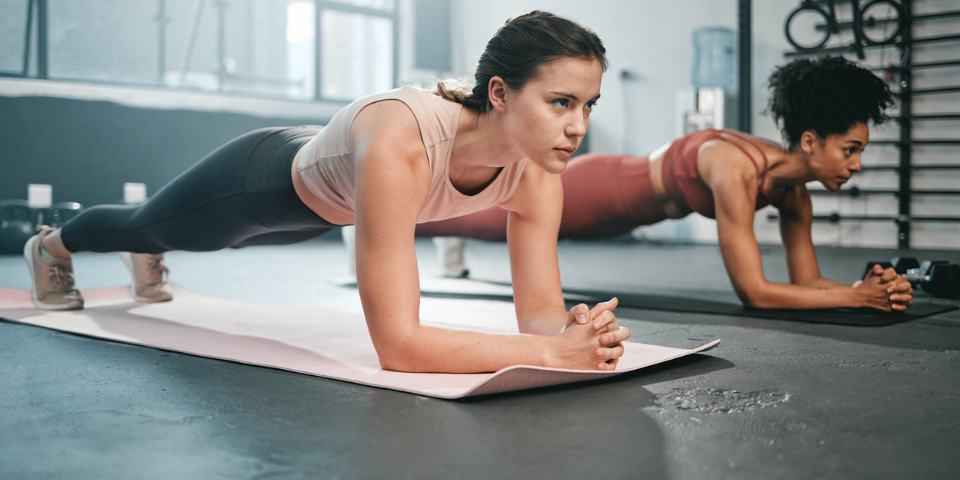
You’ve probably heard the phrase “strengthen your core” often at the gym, in a yoga class, or even from a personal trainer. But what does that actually mean? Understanding how to strengthen your core will help you not only in your training but also in your daily activities.
But before we dig deeper into the “how,” let’s clarify the “what.” The core refers to a complex set of muscles. Many are hidden beneath the outer musculature that people typically train.
Knowing how to work these muscles correctly can have a huge impact on strength, stability, and overall fitness.
What does it mean to train your core?
Strengthening your core means tensing all the muscles in your midsection, which stabilizes your body and allows you to perform a variety of movements.
During physical activity, it is like providing a sturdy link to the center of the body, aiding balance and stability. This is fundamentally different from simply flexing your abdominal muscles by tensing them.
Although your abdominal muscles are an important part of your core, they make up only one part of your core, explains Teresa Marco, MD, PT, DPT, MS, a board-certified clinical orthopedic specialist and owner of Marco Physical Therapy in New York City. She suggests thinking of your core as a “midsection box” with front, back, top, bottom, and sides.
If your abdominal muscles are on one side of that box, flexing your abdominal muscles will only stimulate the muscles on this side. “Strengthening your core” means recruiting all the muscles in this box, but especially your transversus abdominis. “The transversus abdominis runs horizontally from back to front and can be thought of as a belt in the sense that it stabilizes your midsection,” Marco explains.
core muscle anatomy
The core is not made up of a single muscle. Instead, it is made up of a variety of muscles that work together to support the spine and move the body.
- Rectus abdominis: This muscle is located in the middle of your abdomen and is usually what people think of when they talk about abdominal muscles. Marco explains that the rectus abdominis muscle helps bend and flex your torso and essentially works in a head-to-toe direction.
- Transversus abdominis: This muscle wraps around your body horizontally and helps stabilize your spine. Marco likens it to a hug to the inside. These are also the deepest core muscles that “keep the pelvis and lower back stable,” adds Rachel Butler-Green, CSCS, founder of Fit Mindful Body Club.
- External obliques: These muscles are located on the sides and front of the abdomen. Not only does it play an important role in stabilizing your core, it also allows you to twist and lateral bend your core.
- Internal oblique muscle: These muscles, located just below the external obliques (as you progress deeper into your body, rather than toward your legs), help with many functions, such as stabilizing your core, bending and flexing your core, and even maintaining intra-abdominal pressure when you go to the bathroom.
Understanding this structure is key to implementing effective core engagement. These muscles work synergistically to contribute to overall strength, posture, and balance during training and daily life.
Tips for strengthening your core
It takes just one movement to activate this part of your body down to the deep core muscles. Here are some tips for good core engagement, recommended by Marco and Green.
Start with a quick cough
If you’re not sure what it feels like to work your core, Green recommends “doing a quick cough.” Even if you’ve just started working out, your body knows how to train your core, and it knows how to train your core naturally when you cough.
Pay attention to your core when coughing. “The squeeze at the end of a cough is your core activity,” explains Green.
prepare for the punch
When you cough, its central action occurs immediately and is immediately released. But once you understand that, you can move on to replicating that effort in a slower, more conscious way.
To strengthen your core, Green suggests, “squeeze your abdominal muscles like you’re preparing for a punch to the abdomen.” What you should do is “prevent it by tightening up,” says Marco.
Please add your hand
“We also put our hands on your stomach and ask you to feel the muscles,” Marco explains. Feeling your abdominal muscles engage your hands will also help you train the movement until your muscles have memory.
practice other core movements
Some people may not understand how their muscles move during the three basic core movements: thrusting, inhaling, and squeezing. Marco suggests doing all three movements (with your hands on your stomach if it helps) to feel the difference in one session. This may help distinguish them.
How to strengthen your core step by step
Here’s a five-step procedure on how to combine all these techniques to strengthen your core.
- Find a comfortable position. Stand or sit upright. Make sure your feet are shoulder-width apart and your spine is in a neutral position.
- Breathe properly. Breathe deeply and flatten your stomach. Take a deep breath and expand your abdomen. This is a basic process and aims to get you used to the “feel” of your core.
- Take deep diaphragmatic breaths. Rather than shallow breathing that puffs out your chest, focus on “abdominal breathing,” which expands your stomach.
- As you exhale, draw your stomach toward your spine. As you exhale, imagine pulling your belly button toward your spine.
- Please wait a moment: Maintain this engagement for at least a second before relaxing.
If you have trouble maintaining a focused core, you can slowly add time to the final step each time you practice. Ideally, you should be able to breathe again without losing the work of your deep muscles.
Benefits of core engagement
Building core strength is about more than just taking great abs photos (and we don’t mean to downplay the greatness of great abs photos). Exercises that target the deep core muscles can be difficult and frustrating, even for people who exercise regularly.
But the positive ripple effects on athletic performance (whether competitively or in a sport you consider as a hobby) and everyday movements are well worth the frustrating effort to practice for perfection.
increases balance and strength
“The more you strengthen your core, the more balance, strength, and power you’ll have when performing movements and exercises,” says Green. This is because your core muscles act as the center around which all other muscles in your body work.
By strengthening these, you’ll find that your overall body strength and balance will greatly improve.
increase energy and power
A strong core is “where your center of strength comes from,” Marco says. To understand the relationship, she suggests imagining a golfer swinging a club. “You have to have great core stability and strength to hit the ball far,” she explains.
can reduce back pain
Learning how to strengthen your core can also help reduce lower back pain. One study compared core training, which includes exercises to strengthen and stabilize these muscles, with traditional resistance training, and found that core-specific training was more effective in improving lower back pain.
promotes better posture
Finally, working your core plays an important role in standing taller and straighter in your daily life. This is because the muscles involved greatly influence alignment, reducing the chance of slouching and promoting a more confident and healthy posture.
exercises Practice core engagement
Strengthening your core takes time and practice. The list of exercises below gets progressively more difficult, so start with the easy ones and focus on strengthening your core throughout the movement.
1. Supine 90 degree leg hold
Don’t hold your breath at this time. Marco emphasizes that you must continue to breathe calmly.
- Lie on your back with your legs raised and knees bent so that your legs and hips form a 90-degree angle (shins should be parallel to the floor and knees stacked over hips).
- Place your hands on the floor on your stomach or at your sides.
- Be prepared for an imaginary punch to the gut. This will activate your transversus abdominis muscles.
- Press and hold for 3 to 5 seconds, then release.
- Repeat several times.
2. March on the spot
Marco considers this exercise to be the next step after supine 90-degree leg holds. This movement increases your ability to activate your transverse abdominis muscles.
- Stand with your feet hip-width apart and your knees slightly bent.
- Brace your core and bring one knee toward your chest until your thigh is parallel to the floor.
- Hold your feet in this position for 3 to 5 seconds.
- Slowly lower this leg to the floor and repeat with the other leg.
- Repeat this process several times.
3. Alternately tap your heels while supine.
Think of this as an evolution of the supine 90 degree leg hold and a fixed version of a dead bug.
- Lie on your back, raise your legs, and bend your knees so that your feet and hips form a 90-degree angle (your shins should be parallel to the floor).
- Stretch your arms toward the ceiling and strengthen your core.
- Keeping your knees bent, slowly lower one leg until your heel touches the floor. At the same time, extend your opposite arm as far back as possible without lifting your lower back off the floor.
- Make sure to keep your core engaged and your other leg to stay in place in the air.
- Slowly return the lowered leg to its original position.
- Repeat with the other leg and other arm.
- Repeat 5 to 7 times on each side.
4. Dead bug
Concentrate on keeping your lower back on the floor while performing this exercise.
- Lie on your back and tilt your pelvis downward to seal the space between your back and the floor. Lift your feet off the floor and bend your knees so your feet are at a 90-degree angle. Your knees should be stacked over your hips. Extend your arms straight up to the ceiling.
- Lower your left arm behind your head and at the same time extend your right leg long in front of you. Lift both your arms and legs off the mat.
- Return to starting position. Alternate sides to complete all repetitions.
When should you train your core?
Ideally, you should engage your core every time you move your body. “Your body is already smart, so when you move your core should work naturally,” says Marco. This includes during exercise and activities of daily living. However, factors such as lifestyle, muscle weakness, and poor posture can interfere with this automatic activation.
That’s where core training comes in handy. Core training can help you properly train these muscles so they can carry over well into your daily life activities.
The benefits of strengthening your core will affect many of your daily activities, even if you don’t realize it. Picking up and carrying groceries, playing with your dog or kids, and sitting at your desk while maintaining good posture are all easier and less likely to cause injury when you strengthen your core.
Marco emphasizes that you should practice intentional control of your body, much like you control your breathing in breathwork. This conscious activation, in conjunction with automatic activation, strengthens your core and improves your overall physical health.