Bodyweight-only workouts are a good start, but use these weighted exercises to build your core to the next level.
Abdominal muscle training is not just about looking good or improving the appearance of your abs. Yes, these workouts will check both boxes, but these special training plans will also help you understand that your abs aren’t just for show, they’re highly functional.
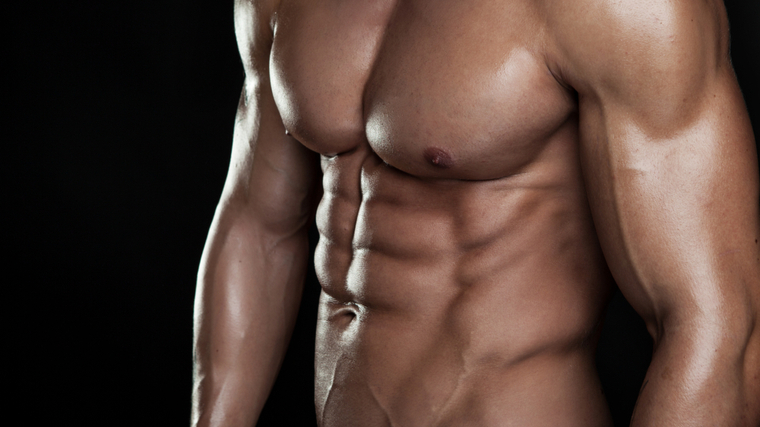
When you start training effectively, you’ll look better, move better, and feel better. These workouts may look easy, but don’t be fooled by their ease. Get ready to build an effective midsection for any workout and anyone you need.
best dumbbell abs training
Dumbbell abdominal muscle training perfect for strengthening muscles
If you want to get stronger, building your abdominal muscles is highly underrated. You might focus on heavy squats and deadlifts. These types of large movements require abdominal engagement, but the amount of direct exposure is limited to properly train these muscles with progressive overload through a longer range of motion. (1)
To really develop serious core and full-body strength, you need to expose your abdominal muscles to a variety of challenges and stimuli. create movement and resist it. This occurs through the sagittal plane during compound movements, when you are resisting flexion and extension (abdominal bending and stretching) using isometric contractions to create tension.
Core strength training
This workout exposes your abdominal muscles to unique stresses that are not yet addressed in your training program. It not only challenges your abdominal muscles to resist forces and change direction, but also to overcome direct resistance in different directions. Perform this workout 2-3 times a week at the end of your other sessions.
dumbbell plank pull through
- manner: Place one dumbbell on the ground and position yourself at your side with your arms extended. Start with your hands, knees, and toes on the floor. Place your shoulders directly above your wrists and your knees directly below your hips. Actively press your hands into the ground while keeping your arms straight and extending your shoulders down and engaging your serratus anterior muscles. Reach your hand furthest from the weight across your body and drag the dumbbell along the floor below you. Shift your weight for 3 to 4 seconds and you should feel your abdominal muscles working. Continue pulling the weight until your arm is fully extended. Do not tilt or rotate your body. Switch hands and return your weight to the starting position.
- Number of sets and reps: Do a total of 3 x 16 reps, alternating each side, 8 reps per side/set.
- Break time: 60 seconds between sets.
dumbbell sit ups
- manner: Lie on the ground and hold the dumbbell ends horizontally, placing them under your chin and over your chest. The key is to keep the weight in contact with your body. This makes the first part of the sit-up much harder (in a beneficial way). It also ensures that your abdominal muscles are performing the movement and not your hip flexors. (2) Dig your heels into the floor and statically pull them back to engage your hamstrings. Curl your torso toward your knees. Once you successfully reach the top, slowly lower your body back to the starting position. Keep your head and shoulders off the floor without fully relaxing between each rep.
- Number of sets and reps: 3×10
- Break time: 60 seconds between sets.
dumbbell side bend
- manner: Stand straight with one dumbbell in suitcase position (hold it in one hand at waist height as if you were carrying a suitcase). Without rotating or twisting, lean your upper body toward your weight and feel a stretch along the opposite side of your body. Maintain a stable base and do not shift your entire weight to the side. An individual’s range of motion will vary based on their overall mobility and strength. Once you reach the maximum comfortable stretch, stretch your obliques and core to return to an upright position. Avoid “overcorrecting” or leaning too far to the other side. Perform all reps on one side before switching hands.
- Number of sets and reps: 3 x 10 times per side.
- Break time: There are no breaks between sides. 60 seconds between sets.
Dumbbell abs training perfect for muscle building
Many people think that abdominal muscles go hand in hand with fat loss, and that’s a legitimate connection. however, abs It’s actually a muscle just like anything else. Just like your biceps, calves, and other muscle groups, training them as they grow can help them stand out and look even better.
How to build more muscular abs
These three movements will make your abs look and feel like they’ve been carved from rich mahogany. To really build muscle, challenge your abs with both more resistance and more volume than ever before. Perform this workout 3-4 times a week.
dumbbell double crunch
- manner: Lie on the ground with your legs bent and your heels raised on a bench, box, or balance ball. Hold dumbbells at your sides with both hands and extend your arms straight over your chest. Squat your upper body, extending your weight straight toward the ceiling instead of forward toward your feet. As you reach, press your heels into the bench and lift your hips a few inches off the floor. Hold the double contracted position for 1 second and slowly return to the starting position. This practice gets messy quickly, so be prepared to get burned.
- Number of sets and reps: 4×8-10
- Break time: There is no break before moving on to the next exercise.
leg raise
- manner: Lie down on a flat bench with your body facing one end and the handles of the dumbbells between your thighs. Hold the bench behind your head and extend it so that it is parallel to the floor. Bend your legs and controllably pull your knees toward you. Tighten your legs to control your weight. Instead of trying to bring your knees closer to your elbows, focus on covering your stomach with your thighs.
- Number of sets and reps: 4×8-10
- Break time: There is no break before moving on to the next exercise.
dumbbell side bend
- manner: Stand straight with one dumbbell in suitcase position (hold it in one hand at waist height as if you were carrying a suitcase). Without rotating or twisting, lean your upper body toward your weight and feel a stretch along the opposite side of your body. Maintain a stable base and do not shift your entire weight to the side. An individual’s range of motion will vary based on their overall mobility and strength. Once you reach the maximum comfortable stretch, stretch your obliques and core to return to an upright position. Avoid “overcorrecting” or leaning too far to the other side. Perform all reps on one side before switching hands.
- Number of sets and reps: 4×10 per side.
- Break time: There are no breaks between sides. Rest for 45 seconds before returning to the first exercise.
Best dumbbell abs workout to lose fat
unfortunately, not specific Abdominal muscle training special ab exercises it is Increase fat loss rate Or weight loss. To improve your body composition, you need to support your health by maintaining or increasing your overall activity throughout the week while adjusting your nutrition. calorie deficit.
Program to reveal abdominal muscles
Here’s a simple and effective ab routine to increase your weekly training load, increase calorie burn, and maintain strength and muscle while reducing body fat. Perform this workout two to three times a week at the end of your other strength training sessions.
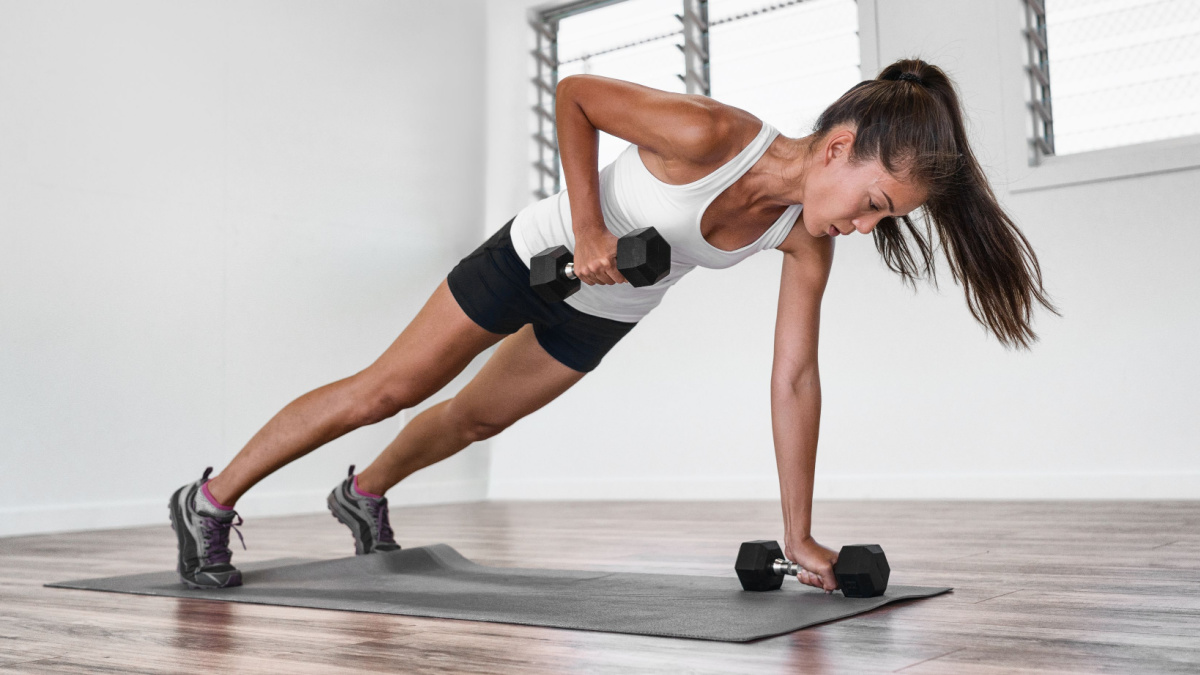
dumbbell renegade row
- manner: Start in a plank position (the top of a push-up position) with your legs straight and your toes on the ground. Extend your arms straight, place one hand on the ground, and hold a dumbbell in your other hand directly below your shoulder. Row the dumbbell towards your ribs while actively pressing your other arm into the ground. Be careful not to twist your lower back or shoulders. Perform all reps on one side before switching arms.
- Number of sets and reps: 3 x 8 times per side.
- Break time: There are no breaks between sides and no breaks before moving on to the next practice.
chest press in hollow hold
- manner: Lie on the ground in a “hollow rock” position. Straighten your legs and lift your heels and shoulders off the ground. Raise your legs slightly higher than your hips and press your hips into the floor to engage your core and stabilize your body. Maintain this static position throughout the exercise. Hold the dumbbells horizontally at chest level, holding each end. Push the weight toward the ceiling and repeat. Reach as far as you can to engage your serratus anterior and obliques.
- Number of sets and reps: 3×8-10
- Break time: There is no break before moving on to the next exercise.
Half-kneeling to chop wood
- manner: Start in a half-kneeling position, holding a dumbbell with both hands near the hips of your “downward” leg. Lift your weight toward your opposite shoulder as you rotate your hips and extend your arms. Return to starting position. Perform all reps on one side before switching legs.
- Number of sets and reps: Repeat 3 x 16 times on each side.
- Break time: There are no breaks between sides. Rest 30 seconds between sets and return to the starting exercise.
abs
Surprisingly, “abs” are not just one muscle. Several muscle groups (some superficial, others deeper, but equally important) work together to control the position of your torso, provide stability, and provide postural support and strength.
rectus abdominis
This muscle is glorified and recognized. major abdominal muscles. The rectus abdominis muscle is divided into several “sections” depending on a person’s unique genetic makeup and tendon placement. This is why some people are only ever able to develop 4-pack abs, while others are able to build 8-packs. This is not about specific exercises or diets, the end result is completely genetic.
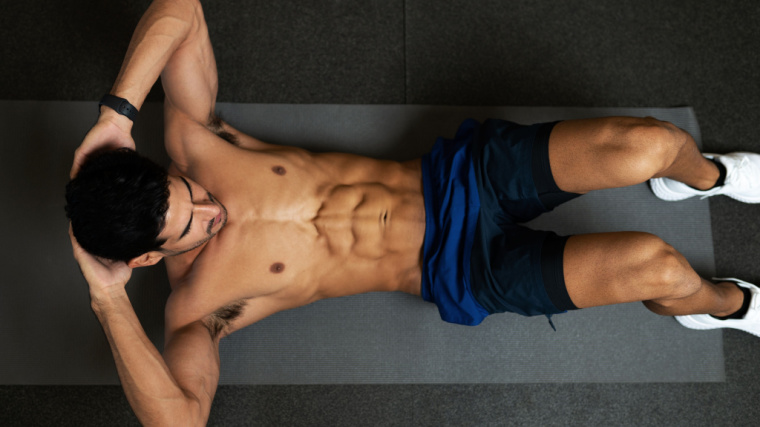
The rectus abdominis muscles control trunk flexion (bending the upper body), resisting extension (bending backwards), and resisting lateral flexion (bending to the side).
transversus abdominis
A deep and powerful core muscle, the transverse abdominis is essential for serious core strength. deeply involved in the creation intra-abdominal pressurestabilize your lower back. The transverse abdominis is also activated significantly, helping to resist flexion and extension and create a stable column throughout the upper body.
internal obliques and external obliques
The obliques are located on either side of the abdominal muscles and are best known for their effectiveness. rotational force And strength. Movements that twist or prevent hip rotation rely on well-developed oblique muscles. They also do not only lateral bend, resist lateral movement.
Warm-up for abdominal muscles and core
As with any other part of your body, a thorough warm-up is important to reduce the chance of injury and perform optimally. When it comes to weighted ab exercises, one very efficient way to warm up is to perform the exercises. no weight before picking up dumbbells.
A full-body warm-up is not required, especially since ab exercises are usually performed at the end of a training session. You can prepare specific movement patterns and directly prepare your muscles and joints by simply repeating the desired exercise several times without adding weight.
For example, you can prepare for strength training by holding a basic plank position, doing a few sit-ups, and doing some weightless side bends before starting a weight-bearing version of the exercise.
Abdominal muscle training is essential
Your abs play an important role in a variety of activities and exercises, but the specific exercises that really challenge your abs are less important. Standard bodyweight-only ab training will only get you so far. Like any other muscle, you need to work on your abdominal muscles and make progress over time by doing more reps, more weight, or both. Make intense ab training a priority and watch your performance and physique grow.
References
- Saeterbakken, R. van den Tillaar, A.H. (2018). Comparison of core muscle activation between prone bridge and 6RM back squat. Journal of Human Dynamics, 6243–53. https://doi.org/10.1515/hukin-2017-0176
- Workman, JC, Docherty, D., Parfrey, KC, and Boehm, DG (2008). Effect of pelvic position on abdominal and hip flexor activation. Strength and Conditioning Research Journal, twenty two(5), 1563-1569. https://doi.org/10.1519/JSC.0b013e3181739981
Featured image: Maridav / Shutterstock