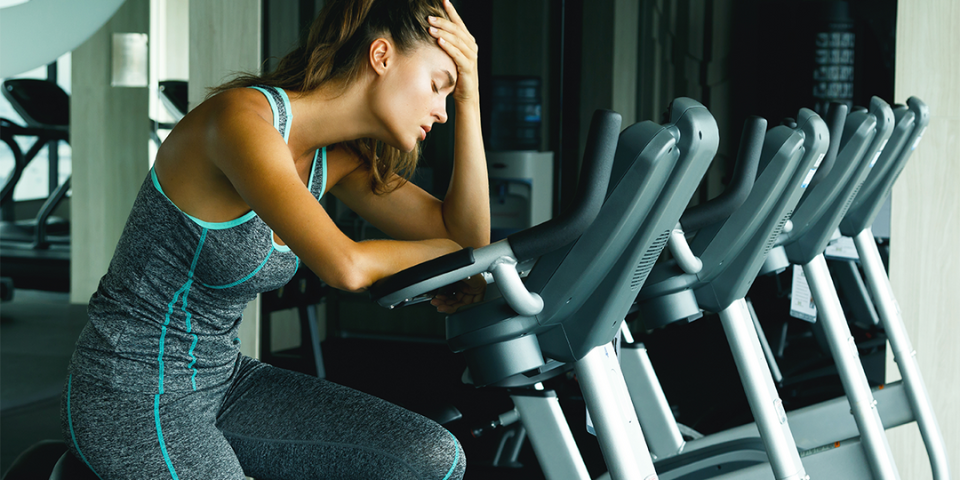
Indoor cycling is not as complex a workout as weightlifting or calisthenics. There is basically one basic movement while sitting. So how much can go wrong?
many. There’s a lot of room for mistakes in cycling, which can lead to inefficient training or worse, injury. We asked fitness experts and cycling instructors about common indoor cycling mistakes and how to fix or avoid them.
1. Sitting too high or too low
The first mistake many people make is not setting up their bike correctly, says Melanie Melillo, CPT.
“The most common mistake I’ve seen over the past 10 years helping riders set up is setting the handlebars too high and the seat too low,” says Jake Morin, CPT, co-owner of CycleBar in Naples, Florida. “If the handlebars are too high, the downward pedal stroke will be inefficient. If the handlebars are too low, it will be difficult to breathe.”
Additionally, sitting too high or too low can put too much pressure on your spine and knees, says Brendan Kirk, PT, DPT, OCS, CSCS, CKTP, Spine & Sports Medicine in Glen Rock, New Jersey.
To set up your bike correctly, stand next to your bike and follow these guidelines:
- The seat height should be about hip bone height.
- Once seated, adjust your grip so that you can hold the handlebars with a light grip while keeping your elbows slightly bent.
- According to Melillo, you need to sit far enough away from the handlebars to keep your spine neutral for longer.
- At the bottom of the pedal stroke, your knees should be slightly bent. “This allows us to safely generate more force,” Kirk says. However, be careful not to bend your knees too much. The pedal stroke becomes “short” or half-finished, says Morin.
2. Riding Tense
Another common mistake is gripping the handlebars too tightly. “We call it the death grip or white knuckle,” Melillo says. “It traps unnecessary tension in your hands.” Many riders end up lifting their shoulders toward their ears while keeping their jaws tense.
Instead, follow these tips to relax.
- Relax your fingertips and grip the handlebars with a light grip.
- Make sure your shoulders are relaxed.
- Keep your elbows softly bent and turned in so they are on either side of your ribcage. “Instead of spreading it out like a chicken wing,” Melillo says.
why? To have a good cycling workout, you need to allow your body to generate maximum power. “If your shoulders are up near your ears and your elbows are out to the sides, you’re not in the best position to maximize your pedal stroke,” Melillo says.
3. Uneven foot position
When cycling indoors, your feet may be held in place by toe cages or clipped shoes. This activates your hamstring muscles as you pull your legs up, explains Andrea Metcalf, CPT, LREA, certified personal trainer and author of this book. naked fitness.
If your feet are pointing down, you’re working your calves, but you’re cutting your hamstrings short. Instead, keep your feet horizontal within the pedals. This allows for a more balanced lower body workout that works your quadriceps and hamstrings in tandem and activates the large muscles of your thighs.
4. Resistance value set too low
“I see riders setting the resistance too low, so they’re pedaling furiously, not getting any benefit from the movement, and even hyperextending their knees,” says Morin. Solution: Create a mild to medium resistance rate as a starting point so you feel like you’re in control of the ride instead of feeling like you’re about to fall off the bike.
5. Not getting enough energy or hydration
When doing your cycling training, it’s a good idea to have a bottle of water within reach.
“Aerobic exercise like indoor cycling can make you sweat a lot, so you need to make sure you replace the fluids you lose. Also, replenish your electrolytes if you’re going for more than 45 minutes,” Melillo says. Hydration supplements like Beachbody Performance Hydrate can help you stay hydrated, replenish important electrolytes, and even improve your endurance while riding.
Also, be sure to properly supplement with enough protein and carbohydrates before and after training to support your activity level and fitness goals.
6. Incorporate upper body exercises
Trying to train your upper body while riding a stationary bike is dangerous and has “very little benefit,” says Garrett Seacat, CSCS, head coach at Absolute Endurance in Manhattan, Kansas. “If you ride a bike and move your upper body up and down while pedaling, you significantly increase your chances of injuring your lower back.”
Additionally, the movement of your upper body weakens your pedal effort, making your workout less effective and reducing your calorie burn. Instead, do a few push-ups as part of your post-ride stretch and cool-down.
7. Regain the calories you burnt
“We have riders who are confident that they’ve burned hundreds of calories and can indulge in pizza and all the sweet things their bodies crave right after the ride,” says Morin. “A quick snack is fine, but your body needs protein and hydration after a workout. Consuming alcohol right away can also negate many of the positive aspects of your workout.”
8. Cycling too hard or too often
Working out too often, always working at maximum intensity, and not giving your body enough time to rest and recover can sabotage your efforts.
“There’s a pitfall to working out as hard as you can every time,” Melillo says. “Your body needs to work out in all different heart rate zones. It needs periods of rest and recovery. As much as it needs hard workouts, it also needs moderate workouts that last a little longer.”
9. Refine your training
“In addition to riding, be sure to do strength training, core training, and stretching,” Melillo says. “All this supports the bike’s peak performance.”
To prevent injury and minimize soreness the next day, stretch for at least 10 minutes to warm up and cool down.
10. Trying to keep up with the Joneses
Cycling classes are competitive, which makes it fun and motivating. But getting carried away can lead to injury.
“We often see beginners trying to catch up to the person next to them in both resistance and speed, but what may be enough resistance for one person to ride the bike may be too much for the person next to them,” says Andrew Blakey, CPT, director of Your Future Fitness in Toronto. “Listen to your body and choose a resistance that is challenging but not painful. Choose a speed and resistance that works best for you, not the person next to you.”
11. Do the same training
“Everyone may have a favorite class or trainer, but it’s best to try all the different classes and trainers,” Melillo says. “You might learn things from one trainer that others don’t. And just because you hate endurance rides or HIIT rides doesn’t mean they aren’t important. Our bodies are designed to find shortcuts, the most efficient way to do it, so you should continue to challenge yourself with different physical and mental routines.”
*These statements have not been evaluated by the Food and Drug Administration. This product is not intended to diagnose, treat, cure, or prevent any disease.