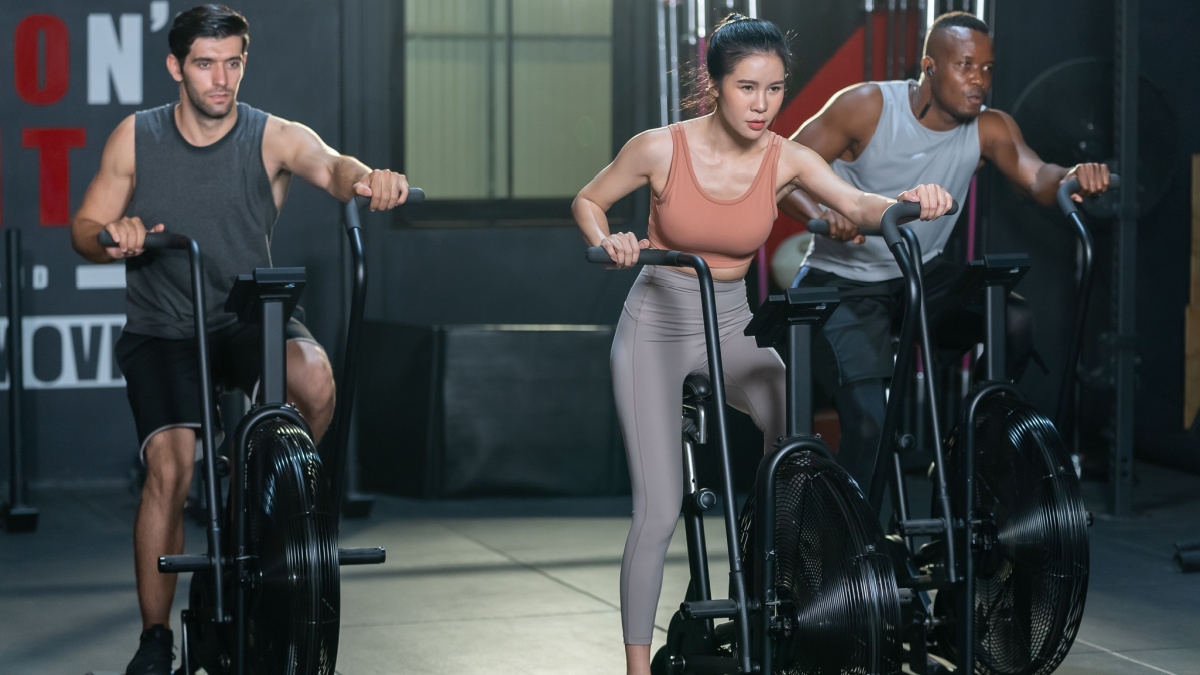
An intense air bike workout that will get your heart pumping.
Modern air bikes are a far cry from the squeaky machines your parents used at the local Y decades ago. Today’s machines are overbuilt and imposing. With larger fans, heavier components, and electronic performance monitors, these machines are designed to take a beating and give you a heartbeat.

The Assault Bike® is one of the few modern resistance fan full body exercise bikes, or “air bikes.” Similar machines include the Echo Bike, Airdyne Pro, and various other models. However, like Rollerblade®, Q-tip®, and Band-Aid®, “assault bike” has become widely known as an umbrella term for all brands of air bikes, or simply as a phrase used interchangeably with “air bike.”
Air bikes work arm and leg muscle groups at the same time without rest, so they are considered the most efficient machine for conditioning, shedding unwanted weight, and training all major metabolic energy pathways.
If you’re lucky enough to have an air bike, check out these grueling workouts.
best air bike workout
Air bike workouts perfect for conditioning
Air bikes are considered to be more strength-oriented than spin bikes because their resistance is much less adjustable. (1) Spin bikes typically pedal between 70 and 110 revolutions per minute; Air bikes reach 40-80 rpm Every minute. (1)
Unlike a spin bike, an air bike’s resistance increases gradually the harder and faster you ride. In summary, air cycling may be the preferred conditioning method for athletes with a strength background or bias.
Air bikes are also available. A more efficient way to train anaerobic capacityor short-term high-intensity endurance. If you push yourself hard enough on an air bike, you’ll lean heavily toward anaerobic glycolysis. This is a system that provides energy when demand exceeds the ability to provide oxygen to working muscles.
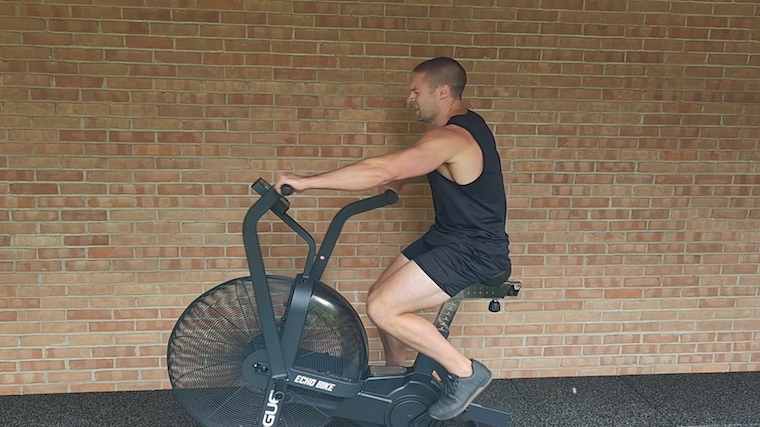
You will also experience the physical pain associated with anaerobic training. Lactate is a metabolic byproduct of anaerobic glycolysis. Workouts that produce uncomfortably high levels of lactic acid tend to be perceived as “hard workouts.” (2)
Compared to Wingate cycling, the gold standard “all out” test of anaerobic fitness, a maximal effort ride of the same amount of time on an air bike produces higher lactate levels. Additionally, these elevated lactate levels decrease more slowly. (3)
Now, lactic acid is not the direct cause of muscle “burn”. Rather, lactate is produced along with hydrogen ions, which can change tissue pH and cause searing burns from high-intensity exercise. (4) believe in the pain. This suffering pays dividends in the following ways. Improving conditioning and fitness.
Modified Sprint Time Trial Interval Training
Unless you’re a special type of masochist, riding an air bike is a physiological benefit, a multi-system adaptation that improves our health and increases our ability to do more work in and out of the gym.
Your go-to conditioning workout should be like a Swiss Army knife. It must be versatile enough to be practical and easy to handle. Specifically, you need to do solid conditioning training. Train all major energy systems (creatine phosphate, anaerobic glycolysis, and aerobic metabolism). A good routine also promotes fatigue resistance, utilizes muscle fibers with great potential for adaptation, and improves overall work capacity.
This air bike workout was inspired by a protocol developed by Danish researchers. The original protocol consisted of six 5-minute intervals at 85% of your maximum heart rate, followed by two 5-minute intervals, five 15-second sprints, followed by 45 seconds of active recovery. (5)
The Danish study included only elite cyclists and triathletes, and this protocol made these very healthy individuals healthier. For the average person, following the same protocols would be insurmountable. Therefore, the volume and frequency of the program will change.
Build towards a full 8-interval protocol by adding one 5-minute interval of consistent training each month. repeat this training once or twice a weekIdeally after strength training or at least 6 hours apart to avoid potential interference.
- manner: Use your arms and legs to pedal during high-intensity intervals. Only the legs can be used during the recovery period. Please warm up thoroughly before running 3 times at 5 minute intervals At the fastest pace you can maintain during the period, 2 minute break or recovery between each interval. After the third recovery period, proceed to the next step. 5 short intervals and 15 seconds sprint followed by Easy recovery in 45 seconds pedaling.
- Number of sets and reps: Do 3 sets of 5 minutes of moderate training and 2 minutes of recovery, followed by 5 sets of 15 seconds of max effort and 45 seconds of recovery.
- Break time: Rest 2 minutes between each 5 minute interval. Take 45 seconds of rest between each 15 second interval.
Best air bike workouts to burn fat
Maybe an air bike The most “restorative” form of aerobic exercise. The stress of training is distributed across both your upper and lower body, rather than overworking one area during your session.
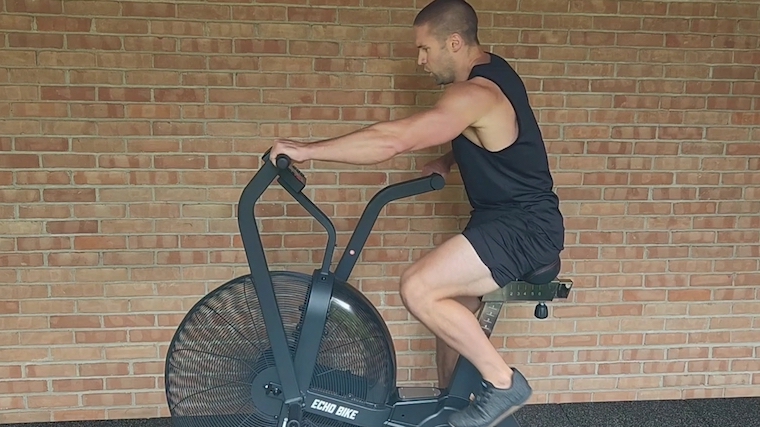
Air cycling is also a “concentric only” exercise. This means that the muscle groups involved must overcome resistance with negligible eccentric or “braking” movements. This allows them to Less likely to cause post-workout soreness.
High loads and/or large amounts of eccentric exercise are associated with delayed onset muscle soreness (DOMS) and varying degrees of damage to muscle cells at the microscopic level. (6) Ultimately, you’re less likely to get sore in the hours and days after a hard assault bike workout compared to more eccentric, high-impact aerobic modes (such as jogging or jumping rope). Additionally, concentric contractions require more energy, which can result in: more energy consumption during training.
Zone 2 Fat Burning Workout
For full-body training that is less stressful and less painful, You can’t beat Zone 2 cardio on an air bike.. Zone 2 refers to low to moderate intensity aerobic exercise, or 60-70% of your maximum heart rate.
To find this range, first estimate your maximum heart rate as 220 minus your age in years. Then multiply that maximum heart rate by 0.6 and 0.7 to determine the upper and lower limits of your training range.
If you’re not using a heart rate monitor, these numbers don’t matter and you can just ride with the best effort you can maintain while breathing through your nose only. In case of intrusion open your mouth and gasp,you training is too intense.
Aerobic training is facilitated by the breakdown of fat in the presence of oxygen. Non-endurance athletes can benefit from aerobic training for purposes such as improving body composition (e.g., fat loss), promoting heart health, and enhancing recovery between resistance training sessions.

Muscles trained through aerobic exercise have improved vascularization and increased mitochondrial density over time. These adaptations may allow your muscles to work harder and recover faster.
of Air bikes are great for aerobic trainingThis is because it trains large muscle groups in your upper and lower body. Unless you hate the monotony of steady-state workouts, break your Zone 2 workouts into segments to stay motivated. This fat loss workout consists of five segments with descending calorie goals. Monitor your progress using the display on your bike.
Repeat this workout 3 to 5 times per week as part of your fat loss plan. Ideally after strength training or at least 6 hours apart to avoid potential interference with recovery and performance.
- manner: Once you’ve warmed up, start pedaling with your arms and legs together. Instead of tracking time, When you pedal, you burn 120 calories, 110 calories, 100 calories, 90 calories, and 80 calories.. The goal is to achieve a “negative split” by completing the following: Each calorie segment is slightly faster than the previous segment. Be sure to maintain Zone 2 intensity throughout your workout by using a heart rate monitor or maintaining nasal-only breathing.
- Number of sets and reps: Five calorie segments: 120 calories, 110 calories, 100 calories, 90 calories, 80 calories.
- Break time: After reaching each calorie goal, rest for 30 seconds either passively (“following” the momentum of the pedals and handlebars) or actively (pedaling at a very low intensity). You should have enough time to take a sip of water or towel off before going again.
Best Air Bike Workout Finisher
A “finisher” refers to a short metabolic conditioning workout that is added at the end of the main workout. For example, after weight training, hop on your air bike to empty your tank and get the most out of your workout.
Since you’ve already trained, your muscle glycogen (a type of stored and readily available energy) levels are likely to be low. “Low-level training”, i.e. training with low levels of glycogen, stimulates adaptations in the energy system. (2) Regular high-intensity interval training allows your muscles to store more available energy and better manage the metabolic byproducts of high-intensity training.
sprint interval training
This Sprint Interval Training (SIT) “finisher” is activate metabolism You’ll feel a sense of accomplishment when you leave the gym. This workout allows for incomplete recovery between short periods of high-intensity riding.
The “fast energy” from the phosphagen system is not completely replenished during a match, so anaerobic glycolysis and aerobic pathways gradually contribute to the energy demands of training. (7)
Translation: you will Train all three major energy pathways In this training. Perform this workout at the end of your weekly resistance training workout.
- manner: Since you just finished weight training, your body should still be relatively warm. Start your workout with two minutes of easy pedaling. Pedal as hard as you can with your arms and legs every minute for 20 seconds (EMOM). Finish with 2 minutes of easy pedaling.
- Number of sets and reps: Perform intervals every minute for a total of 5 minutes.
- Break time: Use the EMOM approach, working for 20 seconds every minute and resting for the remaining 40 seconds. Rest periods can be active (low-intensity pedaling) or passive (following the movement of the steering wheel and pedals).
How to warm up for an air bike workout
A proper warm-up gets your body moving and ready to perform at its best. Body temperature and blood flow increase, which speeds up metabolism and increases oxygen delivery to working muscles.
Joints begin to move more freely. Once the real work begins, you’re likely to start sweating, which helps regulate your body temperature. Try this warm-up before your next air bike workout.
air bike workout warm up
- Ease of riding: Pedal with light pressure for 3 minutes.
- Trunk rotation: While sitting, place your feet firmly on the pegs. While maintaining an upright position, rotate your trunk and extend one arm forward. Alternate your arms with each rotation. Repeat 20 times, 10 times on each side.
- You can ride with just your feet: Ride “easy” for 1 minute with your arms at your sides and using only your legs.
- Riding with arms only: Place your feet on the pegs and ride “easy” for one minute using only your arms.
- Triple ramp up: Pedal your arms and legs together with “easy” effort for 10 seconds. Increase to “moderate” effort for 10 seconds. Move on to 10 seconds of “hard” effort. Run the entire sequence a total of 3 times (90 seconds).
The most effective cardio machine?
Air bikes are relentlessly versatile. You can go all out during interval training or relax for steady-state cardio. Air bike workouts are great for metabolic conditioning and fat loss. It can be used as a stand-alone conditioning or fat loss session, or added to the end of a traditional workout as a “finisher” for sprint intervals. Once your recovery and adaptation are on track, improve your fitness with air bike workouts and set yourself up for future gains.
But you be warned – they can be brutal.
References
- Schlegel, P., Křehký, A., Hiblbauer, J., and Faltys, V. (2022). Air bike as a new method of stress testing. Exercise and Sports Science – Science and Athletic Performance. Published online prior to print. doi.org/10.1051/sm/2022001.
- Buchheit, M., Laursen, P. B. (2013). High-intensity interval training, programming puzzle solutions. sports medicine, 43(5), 313-338.
- Schlegel, P., Křehký, A. (2020). Anaerobic fitness testing in CrossFit. Collection of papers from the Department of Physics Education, Comenius University60(2), 217–228.
- Robbergs, R.A., et al. (2018). Lactate, not lactic acid, is produced by the catabolism of cytoplasmic energy in cells. menstruation, 33(1), 10-12.
- Gejl, K. D., Andersson, E. P., Nielsen, J., Holmberg, H. C., and Ørtenblad, N. (2020). Effects of acute exercise and training on sarcoplasmic reticulum Ca2+ release and uptake rates in highly trained endurance athletes. Frontiers in physiology, 11810.
- Hotfield, T., et al. (2018). Advances in Delayed Onset Muscle Soreness (DOMS): Part I: Etiology and Diagnosis. Sports injuries/sports damage, 32(04), 243-250.
- Bogdanis, GC, Neville, Maine, Bouvis, LH, and Lakomy, Hong Kong (1996). Contribution of creatine phosphate and aerobic metabolism to energy supply during repeated sprint exercise. Journal of Applied Physiology, 80(3), 876–884.
Featured image: Boonkung / Shutterstock