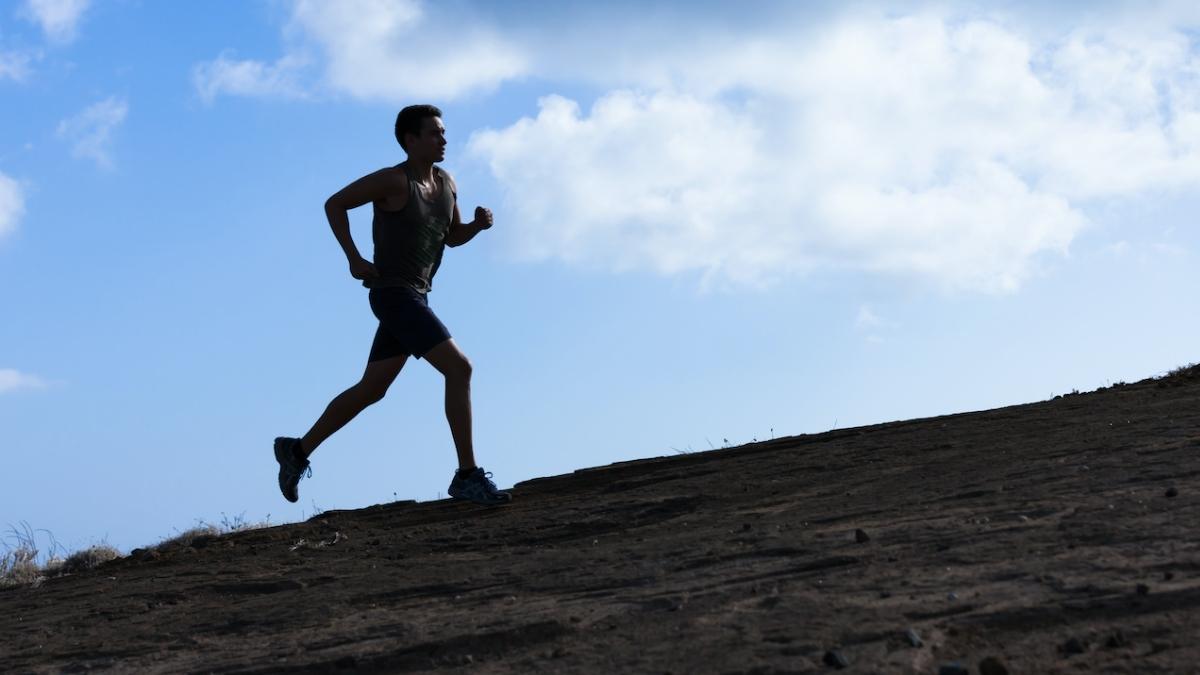
Hill running teaches you the drive phase of a sprint like no other.
I grew up in the late 70’s and 80’s, have been an athlete all my life, and have loved soccer ever since I can remember. As a kid, one of my favorite workout stories that aired on mainstream media was the hill that legendary running back Walter Payton used to condition himself in the offseason.. Look everywhere on the internet and you’ll find stories about Payton’s otherworldly conditioning, how he brought athletes from all sports to train together, and how they ultimately recovered from fatigue. He was one of the most prolific runners in the NFL, arguably one of the best of all time, and the hills were his secret.
I’ve been coaching for almost 20 years now and am obsessed with hill running. I want to thank Peyton for this. The end goal of all my programs is speed, so hills (or stairs if you don’t have a suitable hill nearby) are a must for any speed or conditioning program. I spent most of my career at Cal Poly and San Jose State University, both places with hills and large stadium slopes that are perfect for training athletes.
Why Hills?
When talking about speed, strength and power are important, especially during the acceleration phase.. Sudden bursts of speed are the most important factor: a 40-yard dash, a great running back running through the seam, a batter sprinting down the first base line to beat a throw, a forward exploding toward the hole. The first three to five steps determine the success of your initiative.
Look at the NFL bracket. When you see athletes running well into their 40s, it’s the start that determines a good time. On the other hand, if you see a man stumbling out of the gate or misstepping, rest assured that his time isn’t that great.
Hill running teaches you the drive phase of a sprint like no other. The slope requires runners to use their front legs to climb up. One of the most important speed training cues we use is that the front of the foot is used for speed and the heel for braking. Even larger athletes are forced into a “proper” sprint position due to their size and tendency to make heel-first contact when running on flat ground. Consider the incline that a world-class sprinter makes during the first 50 to 70 meters of a 100-meter run. That’s the attitude we want to teach, and the hills will automatically teach you that.
The most obvious benefit is that hill running puts less stress on your legs. I’ve always thought that pulling a parachute, running with a band, and towing a partner are all ridiculous because they’re all meant to benefit your time on the hill. After squats, Olympic lifting, and kettlebell training, Nothing builds leg strength and explosiveness like sprinting up a hill..
Use hills for lateral applications
The majority of the teams I train for speed don’t really get the opportunity to run straight ahead in their sport (think top-end speed) that track training would benefit from, so we spend almost all of our time doing change-of-direction training. Many children have little or no understanding of how to orient themselves. They don’t understand where their body is in space, are fixated on using their toes to slow down, and have little control over their momentum as they run.
The slope of the chosen hill forces the runner to naturally place the driving foot in a “toe-in” position when climbing sideways. If you don’t, you’ll be much less efficient and almost instinctively feel the need to make adjustments. When on flat ground, one of the key footing points I teach is to subtly toe in the outside foot of the change of direction. This does two things. First, it allows runners full access to the big toe when driving. Second, the direction is in sync with the direction they are trying to go. Believe it or not, this is something that many children don’t have when they first appear. And if they do not have this technique, then you get a slow, powerless attempt to redirect yourself.
Next, gravity is a bully. The natural slope of the hill requires a very strong push. What athletes need on flat ground when trying to accelerate. If I can get my kids to pick up a hill from the side or straight ahead, then they will have context and that understanding on flat ground as well..
Benefits of backward hill sprints
Hill running backwards is a great way to hit athletes. The hill I use is located behind the sports complex at Cal Poly and is about a 35-yard climb with a gradient of about 14%. Sudden. We incorporated backward running into the final stage of hill training.. Part of that is because we want our kids to be pretty uncomfortable, part of it is because of the functional speed of our defensive backs and linebackers, and part of it is because we want our kids to develop some toughness.
When I was in college, I had to backpedal around the outside of the Begley Building at EKU. Truth be told, it was deliberately designed to make us miserable.. The change in slope outside was constant and we were told to do this without stopping for more than 15 minutes, which went hand in hand with misery. It was a completely stupid move, but it taught us a lesson – learn how to push through the pain. There was nothing careless about it, just a burn on my leg that made me gag from my own vomit.
The foot drive created by backhill running is basically impossible to imitate anywhere else.. It teaches children how to push with all their might from the front legs. Remember that acceleration happens in front of your feet and braking happens in your heels. This allows runners to use their legs with the right amount of pressure, where to put their effort, and in an economical way.
Hills teaches running efficiency
Again, the slope forces runners to give their best effort.. Due to the distance, we have to climb a hill. A casual jump or a woman jumping up and down will just make it take 10 times longer to get up the hill. I want it to end quickly, so I naturally try my best.
For my kids, bounding turned out to be the most difficult. Other things may be more painful, but bounding forces them to work as hard as possible and coordinate their movements as efficiently as possible, completely burning out their anaerobic energy system. It’s fun to watch.
Featured image: KieferPix/Shutterstock