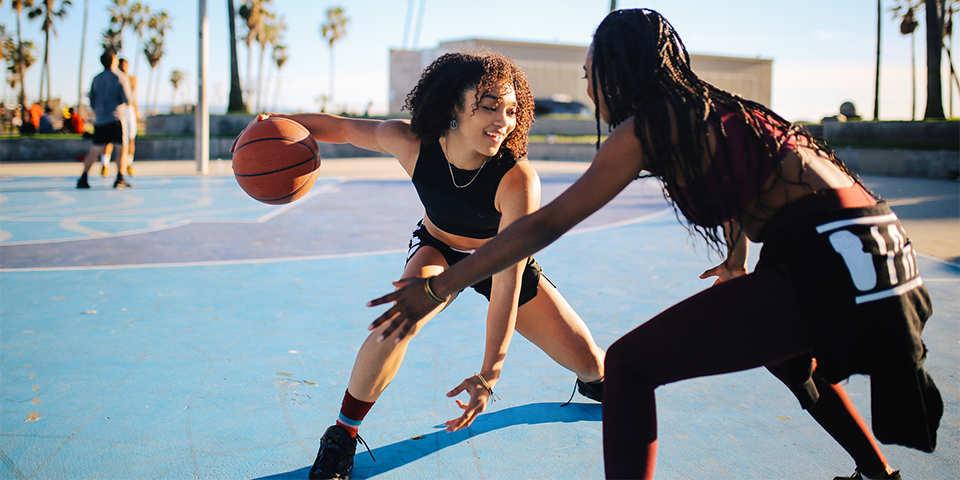
“Lateral quickness” sounds like a skill that only professional athletes possess. After all, most of us mere mortals are just trying to balance a healthy mix of cardio, strength training, and mobility work. Who has time for professional training?
But whether you’re an athlete or not, lateral quickness is related to your ability to move efficiently, and incorporating lateral quickness exercises into your current routine isn’t too difficult or time-consuming.
Plus, wouldn’t it be kind of fun to work out like a pro?
What is lateral quickness?
Lateral quickness is the ability to move your body quickly from side to side. It’s less about speed, that is, accelerating in one direction, and more about being able to move from left to right or change direction quickly while maintaining balance and control of your body.
Why is lateral quickness important?
improve sports performance
In some sports, lateral quickness can be the difference between winning and losing.
“Many sports require athletes to quickly change direction from side to side, whether it’s a shortstop handling a ground ball hit up the middle, a running back avoiding a linebacker trying to tackle him, or a tennis player moving to the opposite sideline to return a shot,” explains Dr. Jordan Duncan of Washington, D.C., owner of Silverdale Sports & Spine in Silverdale, Washington.
This is a behavior pattern that is often ignored.
Beyond the court and arena, lateral quickness can also impact movement in daily life.
“It doesn’t have to be a sport. You just need to have the ability to step aside to avoid someone on the sidewalk or to get out of the way when navigating through a busy concourse at an airport,” says Pete McCall, CSCS, master trainer and host of the All About Fitness podcast.
However, typical fitness routines often do not include side-to-side movements. Common physical activities such as running, cycling, rowing, and even bicep curls all occur along the sagittal plane (moving the body back and forth). This lack of training can leave us vulnerable, Duncan explains.
“We often get injured in areas where we lack strength, coordination, and mobility,” he says. “Many of us can walk or run fairly well, but we have trouble moving from side to side. Training with lateral movements, even when transitioning to more rapid movements, is beneficial for muscle and joint health as well as overall conditioning.”
5 exercises to improve lateral quickness
To improve lateral quickness, you need to train with lateral movement patterns. Both Duncan and McCall recommend a combination of speed drills and plyometric training.
“Doing this strengthens your type II (fast-twitch) muscle fibers and increases the efficiency of your nervous system,” says Duncan. “This increases the speed and force of muscle contractions in the lower extremities and improves lateral quickness.”
The benefits of performing these movements go beyond lateral quickness. Incorporating speed drills into your routine is a great way to increase your cardio, and exercises like skater jumps and banded side walks strengthen the muscles in your glutes, hips, and legs.
1. Lateral shuffle
- Set up two cones 5 to 10 yards apart. Alternatively, choose a fixed marker such as a telephone pole or lamppost.
- Stand inside the left cone with your feet hip-width apart, elbows bent, and hands clasped in front of your chest.
- Keeping your back flat and abs tight, bend your knees, push your hips back, and lower your body into a quarter squat position.
- Keeping your chest up, quickly step your right foot to the right, step with your left foot, and return to your starting position (feet hip-width apart). Repeat this movement, shuffling to the right until you reach the other cone.
- Immediately reverse the movement and shuffle back to the first cone.
2. Lateral band walk
- Wrap a small resistance band around your legs just above your ankles or knees, stand with your feet about shoulder-width apart, and apply tension to the band.
- Keeping your back flat and abs engaged, bend your knees, push your hips back, and lower your body into a quarter squat, shifting your weight toward your heels.
- While maintaining squat and band tension, step your right foot to the right, followed by your left foot to the right.
- Continue sidestepping to the right for the specified number of steps, then reverse the movement and return to the starting position.
3. Cross the mini-hurdle with a horizontal jump
- Stand next to a mini hurdle or similar size object with your feet together.
- Jump across the hurdle and immediately return to the starting position.
- Keep your time on the ground as short as possible and keep jumping back and forth over the hurdles.
4. Skater Jump
- From a standing position, shift your weight to your left leg, bend your left knee, lower your hips a few inches, and lift your right foot off the ground.
- Push off with your left foot and bounce to the right.
- Land softly on your right foot, cross your left leg behind you, and swing your arms across your body in the same direction.
- Pause and repeat the motion, this time pushing off with your right foot and landing on your left.
- Keep jumping back and forth.
5. Jump rope and skier variations
- Hold the rope with your elbows bent, palms facing up, and wrists approximately at waist height. Your wrists should be several inches away from the sides of your body.
- Start with the rope behind your heels and rotate the rope over your head. (Once you have gained momentum, you should be able to move your wrists and keep turning the rope with minimal elbow and shoulder movement.)
- With your knees slightly bent and standing on your tiptoes, jump a few inches off the ground to your right. Jump to the left on the next swing. Continue alternating sides with each jump.