Stretching is an essential part of any workout routine. Increased flexibility makes you more resistant to injury and stronger, but most people only know two types of stretches.
- static: A classic stretch where you hold your muscles in a stretched position for up to 30 seconds (think toe touching) to release tension and make your muscles more supple.
- dynamic: Prepare your body for action with movement-based activities (e.g. core twists, knee raises, etc.).
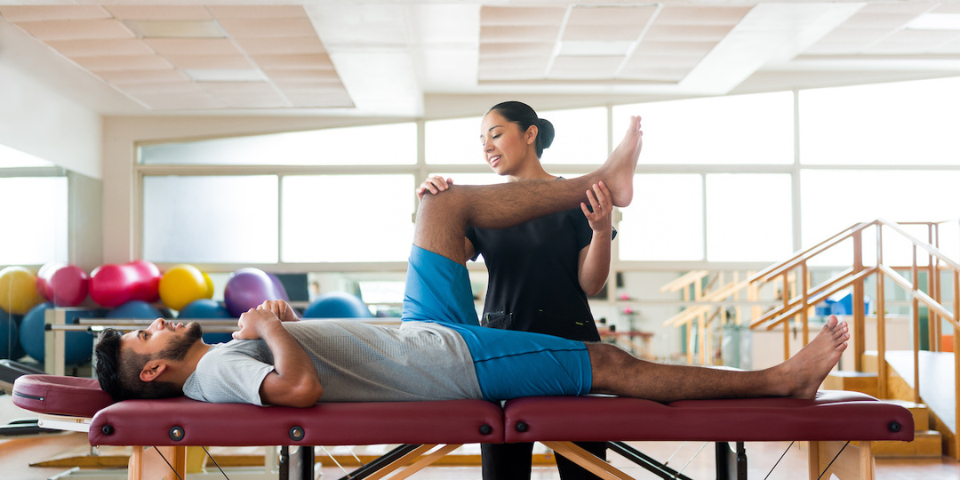
But another way to increase flexibility and range of motion is called PNF stretching. If you’ve ever worked out with a personal trainer who stretches you after a workout, or visited a trendy stretching studio, you may already be familiar with this routine.
Whether you’re a beginner or someone who frequently stretches you, here’s what you need to know about PNF stretching.
What is PNF stretching?
Proprioceptive neuromuscular facilitation, or PNF stretching, involves stretching a muscle to its limit and then contracting that muscle or surrounding muscles to allow for a deeper stretch. This is similar to active stretching. The purpose of this exercise is to increase your range of motion and improve your flexibility.
Physical therapists developed PNF in the 1940s as a way to treat patients with polio and multiple sclerosis, and later began using it for other conditions. “PNF stretching is primarily used in rehabilitation and orthopedic settings to restore flexibility, strength, and coordination to injured muscles,” explains Chris Gagliardi, scientific education content manager at the American Council on Exercise. Most often, this stretch is performed with a trained partner.
However, anyone who wants to improve their mobility can benefit from PNF techniques. “It’s a therapy and philosophy that harnesses the power of the nervous system to enhance movement,” says the personal trainer and physical therapist. Keats SnidemanPT, DPT, COMT, CSCS, LMT.
He explains that breaking down acronyms can help you understand how they work.
- Proprioceptors: Refers to a number of sensory receptors that convey information about body movement and position to the central nervous system.
- Neuromuscular: The connection between a nerve and the muscles/tendons it supplies.
- Facilitation: Facilitating an action or process.
How does PNF stretch work?
Snideman divides the concept of PNF into “direct” and “indirect” techniques. The direct method uses the force exerted by the muscle being stretched, and the indirect method uses the force exerted by the muscle opposing the stretched muscle.
direct technique
Direct techniques are used for tight muscles where stretching is not painful or dangerous. A common stretching method is contract relaxation (CR).
- Stretch the tight muscle to its full range of motion, or stop stretching if it hurts.
- Then, from that position, contract your muscles isometrically (that is, push against the force without moving them) for 5 to 10 seconds.
- After relaxing for a short time, you’ll find that you can stretch your muscles a little deeper.
For example, to stretch your hamstrings, lie on your back and raise your legs as high as possible while keeping them straight. Then press against an opposing force, such as a partner, a strap, or a wall, as if to push your leg back up. However, be careful not to move your legs. Contract your legs for up to 10 seconds, then relax and you’ll be able to lift higher than before.
“This technique works through what’s called ‘isometric contraction-post-relaxation,’ which means the muscle relaxes for a short period of time after an isometric contraction,” explains Snideman.
This relaxation is made possible by a reflex called self-inhibition. When a muscle contracts, sensory receptors called Golgi tendon organs send inhibitory signals that tell the muscle to release tension so it can lengthen. Simply put, when your muscles get too tense, they naturally relax.
You can often perform PNF stretches with a partner or directly using a prop such as a strap or wall.
indirect method
Indirect techniques use antagonistic, or opposite, parts of the body to stretch tight muscles. “If your muscles are weak or have painful contractions, this technique may be for you,” Sneidman says.
Using the indirect technique:
- Stretch the tight muscle to its full range of motion, or stop stretching if it hurts.
- Then, instead of contracting that muscle, contract the other opposing muscle isometrically for 5 to 10 seconds. This loosens and stretches tight muscles.
For example, if you want to stretch your chest, raise your arms so they are parallel to the ground and stretch them back as far as you can without feeling pain. From that point, press your arms against your partner or the wall behind you, contracting your shoulder and upper back muscles to counter the force. The initial chest stretch may increase your range of motion by contracting for up to 10 seconds and then relaxing your arms.
During this technique, the muscles perform mutual inhibition. While one muscle contracts, inhibitory signals cause the opposite muscle to relax.
Indirect PNF stretches are usually performed with a partner, but depending on the muscles you’re targeting, you can also use props to stretch them yourself.
When should I perform PNF stretching?
“There is no consensus as to when it is best to use PNF stretching,” Sneidman says. “But doing this type of stretching before your activity can help you achieve the range of motion you need for any activity you’re about to participate in.”
Flexibility is best developed when muscles are warm, Gagliardi added, so it’s best to warm up before performing PNF stretches.
Also, be sure to perform dynamic stretching after PNF stretching before exercising. Research shows that if you don’t, your vertical jump height and power may decrease during your workout.
What are the benefits of PNF stretching?
“PNF-type stretching often results in faster and greater increases in range of motion than passive or static approaches,” Snideman says.
In a study published in biology of sports In 2016, researchers divided 40 college students with tight hamstrings into four groups. Three days a week for four weeks, students did the following:
- typical static stretching
- PNF stretch
- Mulligan Traction Straight Leg Raise (TSLR) Technique (another technique to increase hamstring flexibility)
- No stretch
Both the PNF stretch and Mulligan TSLR increased hamstring range of motion more than static stretches. Some consider PNF to be the “most effective stretching method” for increasing range of motion.
Points to note when performing PNF stretching
To be safe, PNF stretching should only be performed with a professional, such as a personal trainer or a physical therapist trained in the practice. Report any injuries or strains, Snideman warns, as damaged muscles and tendons can worsen.
This also applies if you have recently had surgery. Stretching the affected muscles can hinder recovery. Once you understand the technique, you may be able to perform PNF stretches on your own.