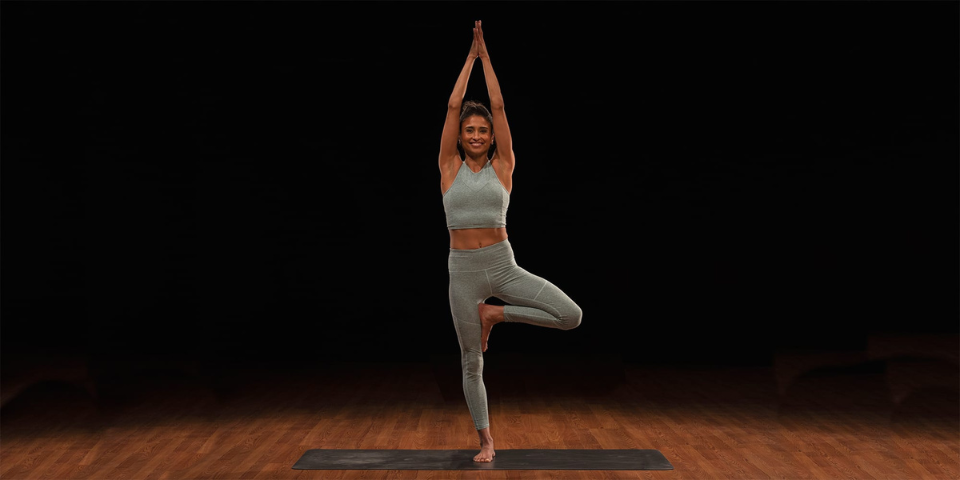
Tree pose is an iconic balancing pose in yoga. Known in Sanskrit as Vrksasana (Also spelled Vrikasana and Vrikshasana), tree pose is “one of the first balance poses practitioners learn in yoga,” says Stephanie Saunders, BODi’s vice president of fitness content and certified yoga instructor.
This is an appropriate name. The feet are the trunk in tree pose, the standing feet are the roots, and the arms are the branches. Tree Pose is a standing balance that is easy to customize and suitable for students of all levels.
tree pose (Vrksasana): Step-by-step instructions
- Stand tall in mountain pose (Tadasana) — chest up, big toes touching, heels slightly apart — palms together in front of your chest, near the top of your mat.
- Shift your weight to your left foot and raise your right knee.
- Swing your right knee outward to the right and place the sole of your right foot on the inside of your left calf or, with the help of your hands, on your left thigh. (Do not place it on your lap.)
- To help with balance, keep your left leg strong and straight without locking your knee as you stare forward at a stationary target.
- Once you feel stable, place your hands over your heart ( anjali mudra Directly above, or directly to the side, as shown in this clip from Yoga52.
- Continue for at least five breaths, then switch sides and repeat.
How to make tree pose easier
Balancing in tree pose is not easy the first time you do it. Doing so will make you stronger. Here are some tips to fix this.
- If you’re having trouble balancing today (and it is!), try tree pose next to a wall.
- A certain amount of hip flexibility is required to place the foot on the inside of the thigh. Sanders suggests placing your feet below your knees until your hips open, or using them on the ground (right heel to left ankle) as a “kickstand.” This eliminates the need to tilt your pelvis to move your feet into position.
How to make tree pose more difficult
It’s easy to make tree pose (or any balancing pose) difficult. Here’s how to strengthen it: Vrksasana.
- Use only your lower body and core strength, not your hands, to move the lifted leg into place.
- Stand with your lifted leg just above the inner thigh or calf of your standing leg without actually touching either of them.
- Close your eyes and try your hand at balance or raise your toes.
- Balance on blocks or soft ground to further engage the muscles that support your feet and ankles.
Beginner tips for doing tree pose
Beginners to yoga often try to get into the “final” version of tree pose before their lower back is ready. To position the foot higher in the leg, the femur must be externally rotated within the hip socket. To keep your knees and hips safe and healthy, focus on opening your hips before putting your legs in place.
Here are some additional considerations when performing Tree Pose, especially if you are just starting out.
- Don’t put your feet on your knees. Both high and low positions are acceptable, but placing your feet on your knees risks damaging your delicate joints.
- Do not lock your standing knee. It may feel safer, but it’s not safe. Especially if it starts shaking. (This happens no matter how long you practice.)
- Breathe! Beginners tend to hold their breath during balance poses.
- Don’t stop posing if you start to wobble. Remember that although trees sway in the wind, they usually manage to stay upright. The wiggle is the strength of the progress.
- If you lose your balance, take a breath and try again.
Benefits of tree pose
Whether it’s your first time doing Tree Pose or your 100th time, you’ll enjoy the following benefits of Tree Pose.
promotes stability
“It can be frustrating, but balance affects every movement in our bodies,” says Sanders. “A little bit of balance training can improve the quality of your movements and prevent injury. Trees are a great place to start, and by increasing stability and strength in your feet and ankles, all balance poses will become more achievable.”
Strengthens the lower body and core
To maintain your balance, you need to activate your core and activate the small muscles that support your feet and ankles.
“Tree Pose uses nearly every muscle in your lower body to help maintain a neutral position for your spine and pelvis. The elevated leg alone uses five different joint movements and at least nine different muscles.”
You’ll feel Tree Pose in your quadriceps and adductors, and throughout the back of your legs from your calves to your glutes.
open your hips
To position the foot on the inside of the thigh, the femur must be able to rotate outward within the hip socket. A stiff lower back will prevent you from going deeper into various poses. Vrksasana Notice how your lower back begins to open up with regular yoga practice. (Make sure to do it on both sides!)