If you’re tired of crunches and have already tried every possible plank variation, try switching your ab exercises to the flutter kick, also known as the butterfly kick. Just as effective as leg lifts, flutter kicks provide a more dynamic (and perhaps even more fun) alternative to typical sit-ups.
And if you’re aiming for defined abs, flutter kicks can help round out your existing ab workout by targeting different muscles than other common core exercises.
Flutter Kick: Step-by-Step Instructions
Performing flutter kicks with proper form will ensure you get the core-strengthening benefits of sit-ups, while protecting your neck and lower back from injury.
To perform a flutter kick with proper form, as in the clip above from LIIFT MORE:
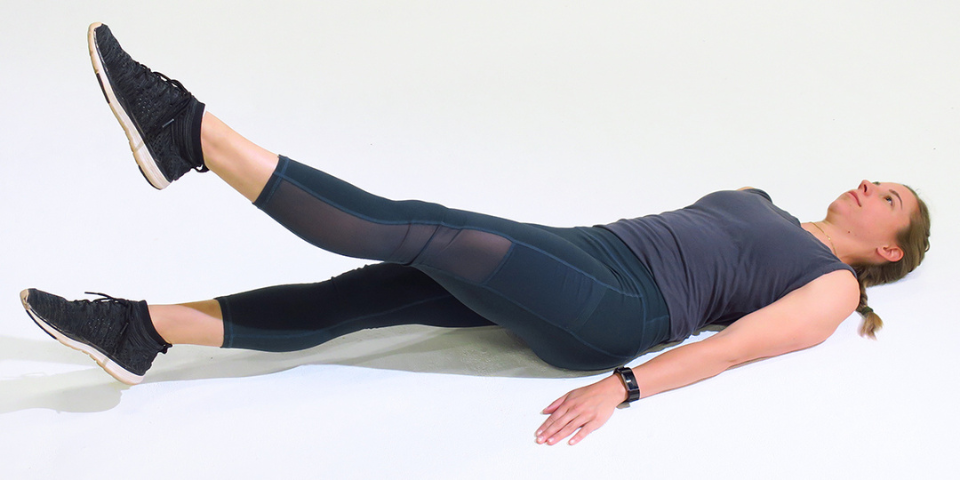
- Lie on your back with your legs straight and your arms by your sides or under your tailbone.
- Raise your legs about 12 inches off the floor while engaging your core and pressing your head, shoulders, and hips into the floor.
- Alternately raise your legs while keeping your legs straight.
- Complete the same number of repetitions on each leg.
How to make flutter kicks easier
- Flapping your feet high off the ground.
- Perform toe taps in supine position.
- Lie on your back, raise your legs, and bend your knees so that your feet and hips form a 90-degree angle (your shins should be parallel to the floor).
- Keeping your knees bent, slowly lower one leg until your heel touches the floor. Make sure to keep your core engaged and your other leg to stay in place in the air.
- Slowly return the lowered leg to the starting position and repeat with the other leg.
How to make your flutter kick stronger
Implement one or more of these enhancements to your flutter kick to make it more challenging.
- Lift your head and shoulders slightly off the ground to engage your abdominals more.
- Flapping your legs faster while maintaining control.
- Perform the exercise with your arms straight above your head and your body in a hollow position.
Advantages of flutter kick
1. Improve your posture
Like other ab exercises like leg raises, planks, bird dogs, and leg lifts, flutter kicks target your core muscles. Strong core muscles are critical to overall health because they stabilize the spine and pelvis, thereby supporting good posture and helping prevent slouching, hunching, and rounded shoulders, which can lead to chronic health problems such as lower back pain.
2. Injury prevention
“Proximal stability equals distal mobility” is a common saying in the field of physical therapy and a principle of human movement. Basically, the stronger and more stable your core is, the more mobile your extremities will be.
A weak core can reduce the mobility of your arms, shoulders, and legs, leading to reduced motor function and, ultimately, injury. Incorporating flutter kicks and other core exercises into your fitness regimen will keep your body moving effectively and prevent injuries.
3. Defined abs
Sure, good posture and injury prevention are important, but what does the butterfly kick do for your body? According to CSCS’s Trevor Thiem, it’s even more effective when combined with other ab exercises like planks and crunches.
“Any exercise that targets the rectus abdominis will work the entire muscle, but most people take a top-down approach to training the rectus abdominis and focus their abdominal training efforts on crunches and sit-ups,” he says. “That’s why the flutter kick is a valuable addition to any exercise arsenal. It provides a new challenge for your abdominal muscles and helps you build a six-pack faster.”
4. Aerobic exercise burns calories
The flutter kick is great for aerobic exercise due to its dynamic nature. Flutter kicks activate your muscles, but they also increase your heart rate. Try incorporating 30-60 seconds of flutter kicks into your next HIIT workout.