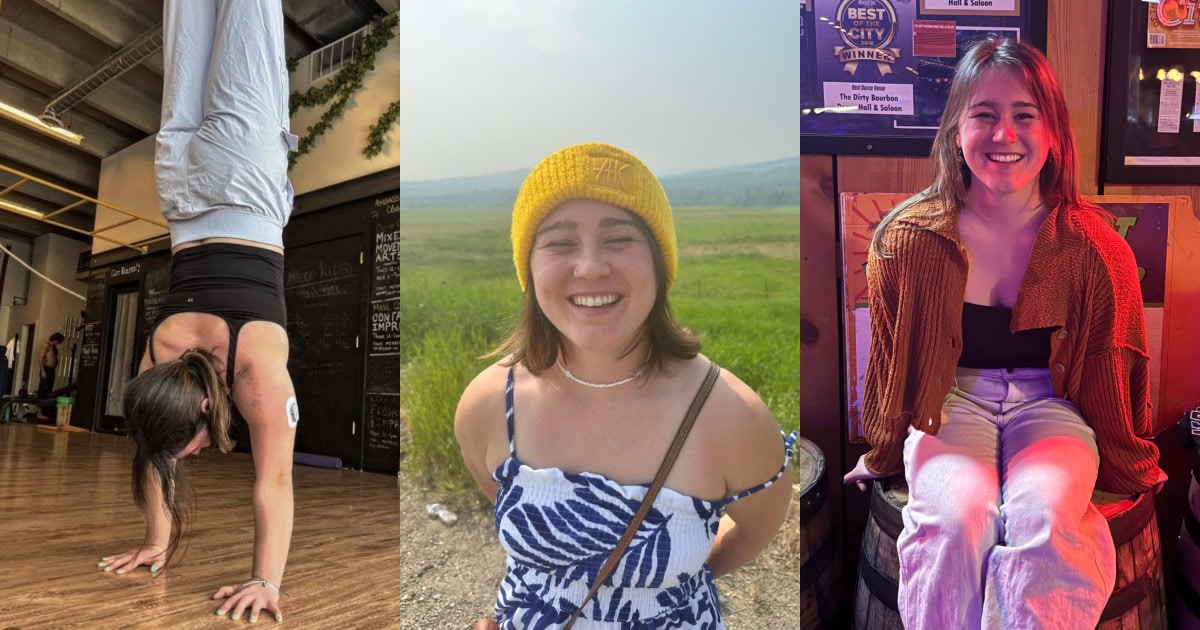
How learning how to do a handstand and finding community helped me find balance in managing type 1 diabetes and recovering from an eating disorder.
I never thought about doing a handstand until I was 22 years old, 20 years after I was diagnosed with type 1 diabetes.
While working as a personal trainer at the CU Boulder Recreation Center, my boss asked me to try out a new handstand class. Never one to ignore the possibility of adventure, I eagerly accepted the invitation.
The first class was difficult. My hands wrestled with the floor like a toddler taking its first steps. The act of kicking myself upside down and trusting my whole body balance completely in my hands was terrifying.
The only drill I was good at was the hollow hold, which we did while lying on the floor at the beginning of class to strengthen our core. From there, I felt increasingly uncoordinated, weird, and out of touch with my true self.
By the end of the class, I was a stranger in my own body. Looking back, maybe that’s why I went back to give it another try.
As a type 1 diabetic, I often felt like an outsider in my own body.
I knew it was over when I heard a knock on the door.
“Claire? This is Giselle, the resident advisor. Can I come in?”
I haven’t moved from the dormitory bed I’ve been lying in for the past two days.
“Claire, I’m with the women from the health service. We’ll unlock your door.”
I looked up, counting the tiles on the ceiling.
I had moved into a dorm at the University of New Jersey three days earlier. For over two years before that, I pretended I didn’t have T1D. I withdrew my insulin to control my weight and became afraid to eat most foods.
The first morning I moved to college, I went to the cafeteria with all the other freshmen. What should have been a simple task turned into a nightmare.
I ate a bowl of granola and underestimated the insulin bolus to keep my blood sugar levels from dropping. Within minutes, my blood sugar level rose to more than 500 mg/dl.
As my classmates filed out of the cafeteria for the first activity of the day, I felt so nauseous that I went to the bathroom.
As I sat on the bathroom floor, thoughts running wild wrapped around my mind like poison ivy.
How would I go to class, make friends, or do anything if I couldn’t manage my T1D?
My worst suspicions were confirmed. I couldn’t take care of myself. that something has value. I went to bed and stayed there until there was a knock on the door.
This wasn’t the first time I heard a knock on the door. My friends and family have been knocking on my door for months. But since you can only lead your horse to the water’s edge, you can only hope to break down the door. And what happens after that?
In the days before CGMs and insulin pumps, my daily routine consisted of finger pricks, blood drips, syringes, insulin vials, and over 120 additional T1D-related decisions per day.
I still can’t understand how my mother did so much more for me from early childhood to elementary school. She is definitely a hero.
When I was in middle school, I took over the management of my T1D, which also happened to be the time when I started becoming more aware of my body. Weight scale and blood sugar meter. The numbers these machines gave me became the all-powerful dictator of my self-esteem.
I strive for perfection, but nothing is as perfect as T1D management.
When the numbers got high, I felt anxious and depressed. I started to give up.
I could have asked my mom for help, but I was too ashamed of my spiraling situation. I lied about my blood sugar levels and told my mom and school nurse that I was in the blood sugar range because my blood sugar levels were consistently over 300 mg/dl.
That was my dirty little secret. The unstoppable snowball of self-destruction and shame grew in size and speed with each passing day. So I decided to slow everything down.
When I was 11 years old, I stopped eating.
Cutting food out of my life worked and even made me feel happy for a few weeks. Even though I ate less, my blood sugar levels remained within a certain range. For a time, I found that the controls were balanced.
However, control was not sustainable and the scales soon tipped towards the extreme. Control began to look like eating an orange and three tablespoons of oatmeal all day long, shoving stir-fried chicken into my socks at the dinner table so my mom wouldn’t notice I wasn’t eating it, and staring at pictures of foods I couldn’t let myself eat on the internet for hours on end.
Control has carved me into a hard, hollow shell of my happy childhood until just a few weeks ago.
People with T1D are twice as likely to develop an eating disorder than people without T1D. Managing T1D requires a great deal of attention to numbers and diet, which, combined with our culture’s obsession with weight, forms a powerful concoction of shame and guilt surrounding our bodies and the food we put into them.
I spent my adolescence in and out of eating disorder clinics and therapists’ offices, but nothing worked.
My high school years were spent denying the existence of my T1D, falling into an eating disorder, falling deeper and deeper into a hole, and learning in the dark to rely on self-harm to find relief.
On this foundation, I went to college to live on my own and take care of myself.
After three knocks, campus mental health services unlocked my dorm room door and saw enough to determine that I didn’t know if I wanted to live anymore.
I don’t remember the ambulance ride from my dorm building to the emergency room. I was shocked at how unbalanced my life was.
A knock on the door signaled an end and therefore a new beginning.
The day I achieved my goal of holding a handstand for 60 seconds, I wasn’t feeling my best.
“Oh my god,” I muttered as the metronome chimed 60 seconds.
I remember hugging my friend Carla and coach Matt. Once the initial excitement wore off, I remember being left with only the solemn realization that achieving this goal would not make me feel any different or better than I did a minute ago.
This change had already happened after days of handstand training and practice, encouragement from coaches and friends, and previous holds of 8 seconds, 15 seconds, 30 seconds, 38 seconds, 47 seconds, 44 seconds, 50 seconds, and 54 seconds.
My daily efforts to take care of myself and practice handstands chipped away at the granite rock of self-fear like slow, inexorable drops of water from a faucet.
My newfound balance was forged out of fear of what I could do if I gave myself a chance.
I dropped out of college after a knock on my dorm room door.
In the culmination of days of calculating insulin doses, dealing with dietary issues, and even navigating some big changes like getting a continuous blood sugar monitor and replacing my insulin pen with an insulin pump, I finally found my way back to a healthier version of myself.
A few months later, I went back to school, became a personal trainer, and eventually found my way into a handstand class. Because I learned that there is nothing more valuable in life than community.
There is no 60 second milestone in T1D management. There’s never a moment when the beat of a metronome lets you know you’ve accomplished something and you can check that goal off your list.
Every day, every time I wake up, I have to choose to take care of myself and answer the knocks at the door.
This choice is easy when you surround yourself with people who care about you. In college, he found community on the intramural soccer team and a club he started for students with type 1 diabetes. I recently made a lifelong friend in a handstand class.
Today I decided to give myself a chance. I chose to take insulin, eat a variety of foods, and be passionate about community and exercise.
I realized that without any of these, my life would become so unbalanced that my very being would tilt off its axis.
The paradox of eating disorder recovery and type 1 diabetes management is a formidable knot that we must continue to study and find ways to begin to unravel it.
To do a handstand, you need to maintain a strong body shape. This means engaging your core and connecting your arms and legs in one tight line all the way to your hips.
If your body line collapses, your feet will fall onto your hands or behind you, causing you to lose your balance. If you can’t shift your weight quickly in your hands, you’ll fall.
Luckily, my T1D administrator taught me to get up and try again.