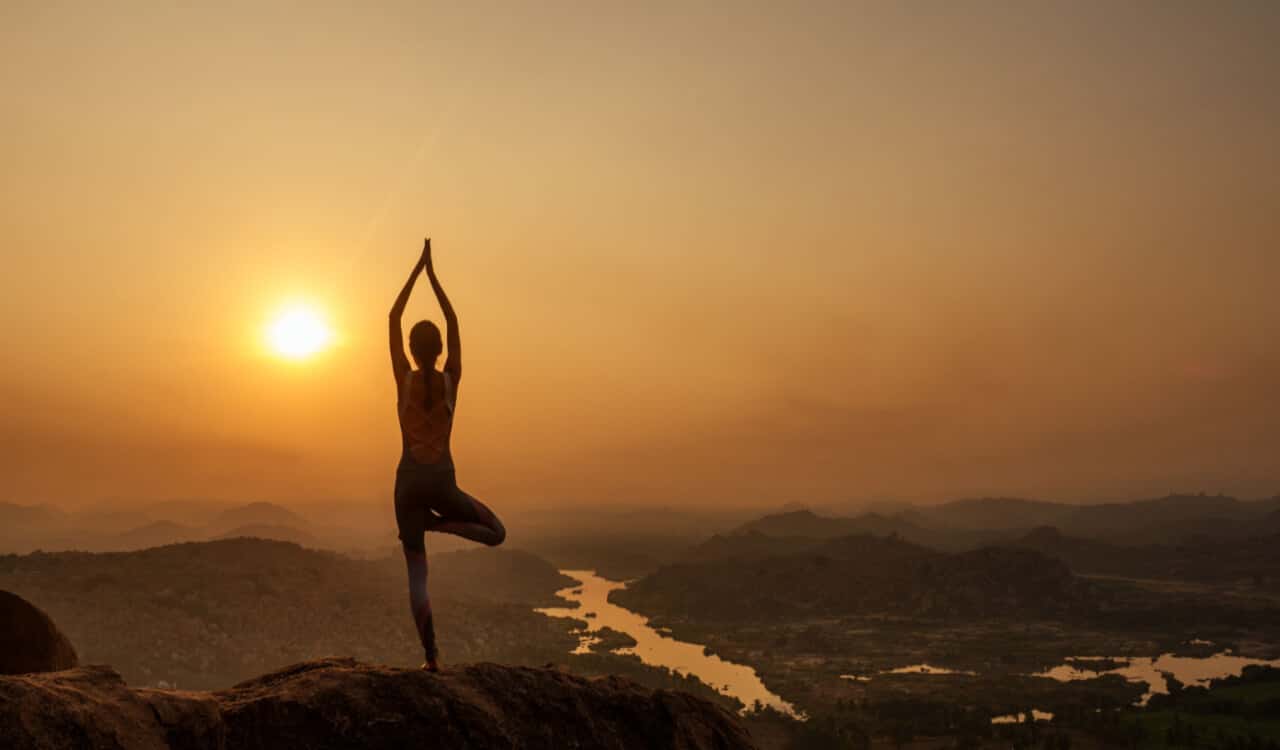
Surya Namaskar is one of them, but it has many benefits. In Surya Namaskar, Surya refers to “sun” and namaskar means “bowing in respect.” It combines 12 yoga asanas in a yoga sequence and has been the most popular yoga kriya for decades.
Practicing Surya Namaskar daily balances the three components of the body: Kapha, Pitta, and Vata, which can help guide your life for the better and influence your creativity and intuition. It’s a simple yet powerful pose, so people of all ages can do it anytime, anywhere.
Types of Surya Namaskar
Over the centuries, Surya Namaskar has evolved and its poses have changed into different styles and variations. Moreover, this is a yogic kriya that never diminishes, but only expands. In reality, Surya Namaskar is incorporated into many different types of yoga styles.
Let’s take a look at them in the sections below.
1. Ashtanga Surya Namaskar: In the Ashtanga Surya Namaskar series, there are two forms of sun salutation. -Type A and B. Type A consists of 9 vinyasas and Type B consists of 17 vinyasas.
2. Hatha Surya Namaskar: This is performed through 12 spinal poses that focus on accentuating the breath. This is one of the most commonly practiced Surya Namaskar styles, and perhaps the easiest.
3. Iyengar Surya Namaskar: Iyengar Surya Namaskar is similar to Hatha practice, but here there is a bit more focus on pace and energy and it is performed at a faster pace than other Surya Namaskar types.
How to do Surya Namaskar – Hatha style
In this section, let’s take some time to look at the 12 classic poses of traditional Hatha Surya Namaskar.
Pose 1 – Prayer Pose (Pranamasana)
execution:
- Start by standing straight in front of your mat, feet together and arms relaxed by your sides.
- Next, close your eyes and place your palms together in the center of your chest. Relax your entire body.
advantage:
- This pose relaxes the nervous system and improves balance. It also helps relieve stress and anxiety.
Pose 2 – Raised Arms Pose (Hasta Uttanasana)
execution:
- Hasta Uttanasana begins with a deep exhalation.
- Then, take a deep breath and stretch your arms out in front of you and raise them above your head.
- Look up, push your pelvis forward and extend your body slightly back.
- Exhale. (Concentrate on breathing in as you lean back and breathing out as you lean forward.)
advantage:
- Stretch and tighten your abdominal muscles.
- Expand your entire body from your heels to your fingertips.
Pose 3 – Hands and Feet Pose (Hasta Padasana)
execution:
- As you exhale, begin to bend forward to your knees. Keep your spine long as you step forward.
- Place your hands on the floor so that only your fingertips touch the floor.
- Bend your knees so that your chest is against your thighs and your head is touching your knees. Hold this position for a few seconds.
advantage:
- It stretches your spine and makes it flexible.
- It also stretches your hamstrings and strengthens your leg, shoulder, and arm muscles.
Pose 4: Equestrian Pose – Ashwa Sancharanasana
execution:
- Next, lower your right leg back, allowing just your knee to drop down and your toes tucked comfortably underneath.
- At the same time, bend your left knee and place your foot flat on the floor.
- Press your fingertips or palms into the floor, roll your shoulders back, and slowly look up.
advantage:
- Strengthens the leg muscles and spine.
- Eliminates indigestion and constipation.
Pose 5 – Mountain Pose (Parvatasana)
execution:
- Slowly and exhale, use control to place your palms on the floor, bring your left leg back next to your right leg, and lift your hips into the air.
- Straighten your back and bring your shoulders closer to your ankles. Take a few breaths.
advantage:
- Your posture will improve and your mind will calm down.
Pose 6 – Ashtanga Namaskara
execution:
- Exhale as you lower down, bending your knees to the ground, keeping your toes curled under you, and pushing your head forward on the floor.
- Keep your elbows flat against the sides of your body. give you more power.
- Now, as you build more strength in this transition, you can lower your chest while keeping your hips and abdomen up in the air.
advantage:
- Improves flexibility of the back and spine.
- Strengthens your back muscles and relieves accumulated tension.
Move eight parts of your body in one pose: your chin, chest, legs, knees, and hands.
Pose 7 – Cobra Pose (Bhujangasana)
execution:
- Keep your hands and feet in the correct position. And inhale.
- Slide forward and raise your chest like a cobra.
- Roll your shoulders back, keep your elbows bent, and squeeze toward each other.
- Look up slowly.
advantage:
- Improves flexibility and mood.
- Stretch the muscles of your shoulders, chest, back, and legs all at once.
Pose 8 – Mountain Pose (Parvatasana)
execution:
- As you exhale, tuck your toes under. (same as pose 5)
- Press back into an inverted V position, stretching through your spine and bringing your shoulders closer to your ankles. Let’s take a little breath here. As you exhale, lift your hips toward the sky and press your hands into the ground.
advantage:
- Increases blood flow to the spinal area.
Strengthens arm and leg muscles.
Pose 9 – Horseback Pose (Ashwa Sancharanasana)
execution:
- Step your left foot forward between your hands and push your pelvis forward. Lift your torso and tilt your head back, arching your back and looking up at the sky (same as pose 4).
advantage:
- It brings flexibility to your leg muscles and tightens your deep core muscles.
- Strengthens the spine.
Pose 10: Hands and Feet Pose – Hasta Padasana.
execution:
- While exhaling, bring your right leg forward and bring your feet together (same as pose 3).
- Bend your knees so that your chest is against your thighs and your head is touching your knees.
advantage:
Improve blood circulation, stretch the body muscles and make the spine more flexible.
Pose 11 – Raised Arms Pose (Hasta Uttanasana)
execution:
- Take a deep breath and stretch your arms out in front of you and raise them above your head (same as pose 2)
- Look up, push your pelvis forward and extend your body slightly back.
- Exhale.
advantage:
- Improves respiratory function, lower back pain, and fatigue. It also aids in digestion.
- The chest expands to allow more oxygen to be taken in.
Pose 12 – Standing Mountain Pose (Tadasana)
execution:
- Finally, exhale and return to the prayer position (same as pose 1).
- Lower your arms slowly and steadily.
advantage:
- Strengthens your thighs, knees and ankles and improves your posture.
- Tones the waist and abdomen, improves agility and blood circulation.
Practicing these 12 poses constitutes one cycle of Surya Namaskar. Ideally, doing 12 to 15 cycles a day will give your body all the benefits it needs and keep you healthy for a better tomorrow.
- Dosha balance: Pita, Kapha, and Vata are three doshas that can become imbalanced due to various reasons. It is greatly influenced by weather, food, daily bad behavior, work stress, lack of sleep, etc. However, by practicing Surya Namaskar daily, you can keep your doshas in the right state.
- Weight loss booster: By simply stretching your abdominal muscles, you can definitely lose excess calories through Surya Namaskar. It also controls hormone secretion from the thyroid gland, which causes weight gain.
- Improve your mental health: Surya Namaskar is very important in strengthening concentration and relaxing the mind while reducing drowsiness, physical stress, worry, and negative emotions. You can activate your brain by activating your spinal cord. Just 15 minutes of practice every day can give your brain big results.
mofobond Notes
Surya Namaskara is a powerful practice with each of the 12 steps having its own benefits. It is best to do it at sunrise on an empty stomach. Apart from the physical benefits, it reduces stress and gives you energy.
conclusion
The physical benefits of Surya Namaskar are many. This 12-pose yoga kriya lubricates all the joints of the body by synchronizing with the breath, improving physical health and mental focus. Doing 12 rounds of Surya Namaskar regularly will not only give you immense benefits of self-discovery, but will also keep your body healthy from the inside out.
Disclaimer: The purpose of this article is solely to spread knowledge and spread awareness. It is not a substitute for professional medical advice.
Frequently asked questions (FAQ)
Q. What are the 12 steps of Surya Namaskara?
Surya Namaskar begins with Pranamasana (Prayer Pose), then Hasta Uttanasana (Raised Arms Pose), then Hasta Padasana (Hands and Feet Pose), Parvatasana (Mountain Pose), Ashtanga Namaskara (Eight Limbed Pose), Bhujangasana (Cobra Pose), then Parvatasana (Mountain Pose) again, Ashwa Sancharanasana. (Equestrian Pose), Hasta Padasana (Hands and Feet Pose), Hasta Uttanasana (Raised Arms Pose), and finally Tadasana (Standing Mountain Pose).
Q. How many times in a day should Surya Namaskara be performed?
If you are a beginner, stick to doing it 4-5 times daily. You can increase the number of sets as you practice. However, if you feel any discomfort or pain, please see a doctor immediately.
Q. What are the benefits of Surya Namaskara?
Practicing Surya Namaskar regularly will benefit you in many ways. It helps you lose weight, strengthen and tone your muscles and joints, improve digestive function, improve respiratory health, and manage stress.
Q. Can I lose 10 kg with Surya Namaskara?
Yes, it will help you lose weight, albeit gradually. Losing 2 kg in a month is called a healthy weight loss schedule. One piece of Surya Namaskar provides 13.90 calories less. However, relying solely on it to lose weight isn’t ideal. There are many factors that can help you lose weight in a healthy way, including eating a balanced diet, improving your sleep cycles, and reducing stress.
Q. When is the best time to perform Surya Namaskar?
Surya Namaskar can be practiced at any time of the day. However, sunrise is considered to be the best time to go as sunrise refreshes your body and mind.