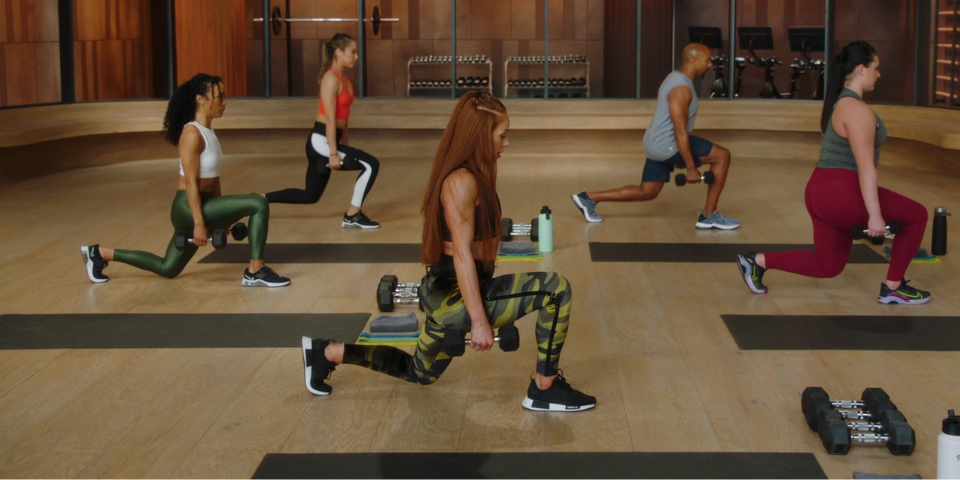
There’s one simple reason why walking lunges strike fear into gym-goers. That’s because it’s difficult. But fitness professionals love it because it gets results.
“I always enjoy the groan when a client realizes walking lunges are on the menu for the day,” says Tom Bigert, DPT, CSCS, owner of EBM Fitness Solutions.
Although the movement itself is easy to learn, walking lunges develop your sense of balance, strengthen your core, and get your heart rate up. At the same time, your quadriceps and glutes will be on fire.
What is a walking lunge?
A walking lunge is essentially a forward moving lunge. Instead of bringing your lunged foot back to the starting position, step your back foot forward.
Walking lunges are an effective bodyweight exercise that, if performed properly, can help strengthen and build your butt and leg muscles. You can use it as a strength-building move in circuit training, or as a dynamic stretch in your warm-up if you’re already fairly fit.
You can also make walking lunges more difficult by adding resistance variations, such as dumbbell walking lunges, overhead walking lunges, and barbell walking lunges.
Walking lunges: step-by-step instructions
- Stand with your feet hip-width apart and your hands on your hips or holding two light dumbbells by your side.
- Step forward with your right leg, taking a step that is just under twice your normal walking stride.
- Bend your right knee about 90 degrees (or as low as you can comfortably go) and lower your left knee so it is just above the ground. The back knee should also be bent at an angle of about 90 degrees.
- Put your weight on your right leg and push off your left leg, straighten your leg and bring your left leg forward to meet your right leg and return to a standing position.
- Repeat on the other side, pushing your left leg forward.
- Continue moving forward by alternating legs for a specified distance or number of steps.
When performing walking lunges, be careful to keep your back knee pointing straight in front of your body and not rotate inward, especially when stepping off your back foot. Keep your chest up, shoulders back, and core engaged for balance.
Walking lunges: effects and muscle function
Walking lunges are easy to master, but difficult to perform. A great addition to your training routine. Here are some of the main benefits of walking lunges.
1. Versatility
“Walking lunges have many benefits, including the ability to perform them anywhere,” says Rebecca Miller, CSCS, Master of Kinesiology, NASM Certified Personal Trainer. “They work different muscles, and you can change the muscle changes by adding weight.”
You can also modify the walking lunge with the following variations.
- speed up
- Add half reps at the bottom
- Add a twist or isometric hold to the bottom
- Perform curls and overhead presses “while walking”
- Hold the barbell above your head throughout the exercise
- Performed on an incline or descent
2. Lower body strength
In addition to working your core muscles, walking lunges also target your lower body.
If you’re aiming for more defined quads or a more shaped rear, walking lunges will strengthen and build almost every major muscle from the waist down.
3. Functional fitness
Walking lunges are also considered a functional exercise, according to NASM-certified personal trainer Rachel Fisk, NC. Adding walking lunges to your workout will not only improve your overall fitness, she says, but it may also make everyday tasks like carrying groceries up the stairs or running to catch the bus easier.