Yoga is truly suitable for all bodies. However, if you do yoga the “right” way, with an emphasis on proper breathing, posture, and form, you can be sure to reap the benefits of yoga while keeping your body safe.
“Coordination is very important,” says Mickey Duran, BODi’s Yoga52 instructor. “Yoga poses should help strengthen the body, not cause injury.”
Proper yoga form, as demonstrated in classic yoga books and in programs like Yoga52 and Beachbody Yoga Studio, was developed for reasons far beyond aesthetics.
“Classical poses (and alignment) can be difficult, but they are the safest place to be,” says Lauren M. Fishman, MD, who has worked extensively with BKS Iyengar and published research on the healing effects of yoga. “The classic pose puts less stress on ligaments, tendons, and cartilage than other versions.”
Duran says it’s common to feel frustrated when you can’t “master” your yoga form fast enough or when you can’t move the way you want. She likens it to learning how to walk: “You just learn, practice, and one day you’ll be able to do it.”
But don’t rush. That’s how injuries happen. Below is a list of common mistakes in yoga form and how to correct them. Most experienced practitioners make the same yoga form mistakes you are demonstrating.
“Your yoga poses may not look like the photos or the others in your class, but notice how the poses change. feel” recommends Anne Swanson, MA, C-IAYT, E-RYT 500. Yoga isn’t painful, but you still need to feel it something.
1. Wrinkle your hands while on the floor
Have you ever found yourself in Downward Dog pose and noticed that your palms start to lift off the floor? “The wrist is an injury-prone area, and injuries can occur if you don’t properly distribute your weight across your hands,” says Yoga52 instructor Odette Hughes.
correction: Keep that hand flat. “Just paying attention to your hands is usually enough to correct what’s going on,” Hughes says. “I ask students to keep their fingers spread apart and press evenly from the little finger side to the thumb side.”
2. Too much soaking in Chaturanga
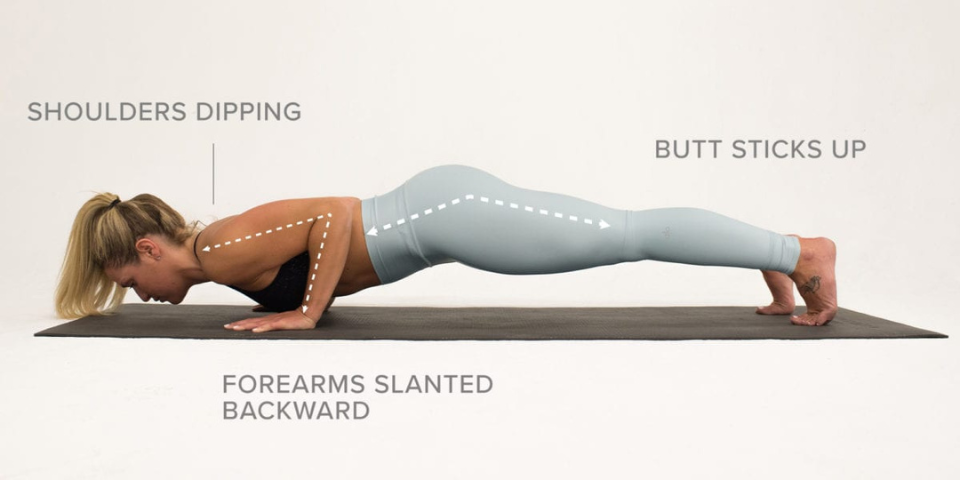
chaturanga dandasana “” is a challenging but common pose, and it’s easy to get too low, especially in Vinyasa flow classes where it’s used repeatedly as a transition. “The combination of poor form and repetitive movements can lead to shoulder injuries,” says Marie Grujicic-Deraj, Yoga52 instructor.
correction: Please adjust the depth. “Just lower it halfway so your elbows are at a 90-degree angle, but never lower,” explains Grujicic-Delege. “Make sure your shoulders are in line with your hips and elbows.” If you can’t maintain that form, drop to your knees.
3. Put stress on your front knee in pigeon pose
Pigeon pose feels great in your lower back, but you often end up putting your front knee at risk to feel the stretch. “Most teachers encourage their students to place the front of their shins parallel to the front of the mat,” says Yoga52 instructor Brent Laffoon.
It would be great if you could do that! However, if you force yourself to do it, you may put strain on your knee ligaments.
correction: Forget parallels if they cause pain. “Try drawing the heel of your front foot toward your groin so that your thigh and knee point a little more forward,” Laffoon says. “You’ll get a great stretch this way too. In fact, if you have sensitive knees, this will give you an even better stretch.”
4. Round your spine when bending forward.
During sun salutations and other sequences, you may be tempted to arch your back as you bend forward toward your toes. “As a guideline, fold from the waist, not from the back,” says Hughes. “This puts a lot of pressure on your lower back, but in return there’s very little stretching.”
correction: Find space elsewhere in the pose. “Usually when you round your back, you’ll find your hamstrings are tight, and that’s perfectly fine,” says Grujicic-Delage. “All you have to do is bend your knees.” Keep them bent as you come out of the forward bend.
5. Knees and ankles are misaligned
Many standing yoga poses include lunges, and it’s common to see students’ knees bending in or out relative to their ankles.
The knee is a modified hinge joint, Swanson said, so it can rotate slightly when you bend it, like in a lunge or warrior pose. “Rotation puts uneven pressure on joint structures, which can cause damage over time,” she says.
correction: Place your knees directly above your ankles. By doing so, “the pressure on the joint structures is more even, preventing potential damage,” Swanson says. “If you notice that your knees are constantly moving in and out in certain poses, try giving yourself more space across the width of your mat,” adds Hughes.
6. Bring your shoulders closer to your ears
Squatting is common in yoga because it tends to overstrain the upper trapezius muscle, Swanson says.
“When you raise your arms above your head, like in Warrior Pose or Tree Pose, you often lift your shoulders too high and squeeze them toward your ears,” she says. It can also occur with deep backbends, such as upward facing dog, which “compress the cervical spine,” Hughes says.
correction: Keep your shoulders relaxed. In standing poses with your arms raised above your head, find a balance between squeezing or lowering your shoulders. (“There is a middle ground,” Swanson says.)
If necessary, extend your hands to your shoulders. Also, in an updog, “use a lot of pressure with your hands, keep your gaze forward rather than up, and pull the top of your head up to keep your neck long,” advises Hughes.
7. Compress your lower back with backbends
The name “backbend” is a bit of a misnomer. There’s a lot more going on than the name suggests. Therefore, if you only focus on the bending part, you may end up with a camel or wheel pose in your lower back.
“Whenever you do a backbend, it’s important to use your legs and core to lengthen your spine,” Laffoon says. This prevents strain on your lower back.
correction: Change your focus. “In camel pose, you need to press your shins and the tops of your feet (or the balls of your feet, if you’re tucking your toes) firmly into the floor,” says Laffoon. “Not only does this help move your hips forward in a healthy way, but it also helps create a foundation for lengthening your spine. Tighten your abdominals to protect your lower back, lower your shoulders to create space for your thoracic spine to arch, and lift your chest.”
8. Forget your core.
With so much to remember in yoga, it’s easy to skip or forget certain aspects of the poses, like working your core. “Your deep core muscles stabilize your spine, so it’s important to keep them engaged,” says Grujicic-Deraj.
Not just during poses. “Students tend to rush themselves and forget to use their core support when transitioning from pose to pose,” says Hughes. “Many injuries occur during poses.”
correction: Stay calm and focus on your core. “I encourage my students to move more fluidly, even if they’re moving quickly, so the movements become more gradual,” Hughes says. “The reason for this is not to look good or make your movements more graceful (although that is the case), but to train your joints and muscles to control and stabilize every part of your arc of movement.”
9. Hyperextending the elbows in downward dog
I am the representative of this mistake, and it is intention Please be careful as this may cause injury. If you’re a flexible person, you may find yourself overextending your arms and putting too much stress on your elbows.
“Excessive extension of the arm while supporting weight, such as down dog or up dog, places uneven pressure on the structures of the elbow joint, which can lead to injury and osteoarthritis over time,” says Dr. Swanson.
Fix: Redefine “straight” arms. “To maintain joint conformity and integrity, you need to increase strength and stability,” says Grujicic-Deraj.
Spread your hands slightly apart and bend your elbows slightly. Work your biceps, then rotate your upper arms outward to work your triceps, she added.
10. Place your feet on your knees in tree pose.
Doing tree pose with your raised leg resting on your standing knee is (unofficially) the biggest mistake yogis make. But it’s the easiest to fix.
“As a general rule, never press on the joints,” says Grujicic-Delege. “Pushing on the inside of your knees can cause your hip joints to sink instead of being lifted (and strengthened).” Also, wobbling can put stress on your knees.
Fix: Grow the tree slowly. Practice tree pose with your feet above or below your knees and proper yoga form.