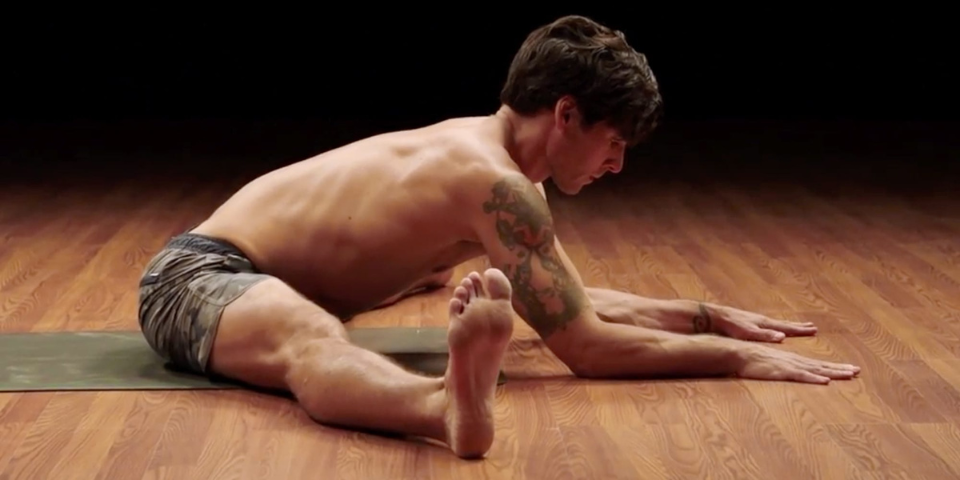
The seated forward bend with legs spread (commonly referred to as the pancake stretch) is a basic pose that, when fully expressed, offers considerable flexibility. Also known by its Sanskrit name Upavishta Konasanathis position deeply stretches the lower back, groin, hamstrings, and lower back.
Here are tips on how to do it with proper form and how to make it easier or harder.
Sitting forward bend (pancake stretch): step-by-step instructions
- Sit with your legs stretched out on the floor and spread them as far apart as possible without straining. Your knees and toes should point directly toward the ceiling, and your feet should be bent.
- Focus on your pelvis and note its tendency to tilt backwards. If so, try shifting your weight forward toward your pubic bone.
- Begin walking forward with your hands along the floor between your feet, focusing on your hips, not your hips, while avoiding rounding your spine.
- Walk your hands forward as far as possible, keeping tension in your quadriceps, and continue for 5 to 10 long, smooth breathing cycles.
- Slowly return to an upright position, placing your hands under the backs of your knees and closing your legs.
How to make the pancake stretch easier
Sitting on the floor with your legs stretched out is very difficult for many people. This is primarily caused by tightness in the hamstrings and lower back. Fortunately, there are modifications and variations to the pancake stretch that make it accessible even to beginners with limited flexibility.
- Sit on a yoga block or folded blanket. This allows you to tilt your pelvis forward.
- Sit with your feet further apart. This modification often allows you to stretch forward more freely.
- Wrap the belt around your legs and try to grab onto something. Next, lean forward and focus on lifting your chest toward the ceiling.
How to make pancakes harder
If this pose is “too easy” to you, you probably have exceptional mobility or are very bent. Try to sit directly above your sitting bones and keep your pelvis in a neutral position without tilting forward. In general, bendable bodies often need to focus on stability rather than mobility during this seated forward bend.
- Add a lateral stretch. Without losing the rooting motion of one leg, fold the other leg and work on lifting and stretching your torso over it. This introduces a twisting element and creates a stretch on the opposite side of your lower back.
Benefits of pancake stretching
- Stretch your hamstrings, adductors, and lower back.
- Activates core musculature.
- Strengthens the erector spinae muscles.