If you think yoga is all about doing handstands and contorting your body into nearly impossible poses, you should know that there are several different ways to practice yoga. For example, Gentle Yoga is suitable for just about anyone, whether you’re a beginner or a veteran.
“Gentle yoga offers a compassionate approach to nurturing the body,” says Sarah Cummins, RYT 500, E-RYT 200, YACEP yoga instructor and certified personal trainer. “It’s often taught in a way that makes it easy for everyone to participate.”
What is Gentle Yoga?
Gentle yoga is a slow, quiet practice that typically involves holding poses for long periods of time.
“Gentle Yoga is taught in a variety of ways, based on the instructor’s yoga style, lineage, and experience,” Cummins says. “Gentle yoga combines a slow flow with restorative positions held for long periods of time, with an emphasis on breathing and meditation practices.”
Each class is different, but here’s what you can expect from a gentle yoga class, according to Cummins:
- Tips on how to adjust your body safely and properly.
- Tips for using props such as blocks, straps, blankets, and bolsters to aid alignment and relaxation.
- There are fewer transitions from sitting to standing or kneeling to lying down for a smoother, more relaxed experience.
- The rich options and modifications “meet you where you are and give you space to explore the pose,” she says.
gentle types of yoga
Some yoga studios offer “slow flow” classes, a gentler form of vinyasa yoga. And both restorative yoga and yin yoga are considered “gentle” yoga practices.
Although restorative yoga and yin yoga are both gentle on the body, there are some differences between the two styles.
Restorative yoga: It incorporates approximately 5-6 postures aimed at slowly recovering the body. Hold each pose for a few minutes using some props. The goal is complete comfort, releasing all muscle tension.
Yin yoga: Although fewer poses are held for longer periods of time (3 to 5 minutes), they “penetrate into the deepest layers of connective tissue to restore elasticity, mobility, and energy to tight muscles. Most yin poses are completed entirely on the floor and are likely to feel more difficult than restorative yoga poses,” Cummins says.
Is Gentle Yoga suitable for beginners?
Gentle Yoga is an excellent introduction to yoga for beginners. “Gentle yoga allows students to move slowly and mindfully through poses and practice yoga in a safe and effective way,” Cummins says.
But that’s not the case only For beginners.
“This is a challenging exercise for young and old, flexible and inflexible people. It’s also great for pregnant women and people recovering from an injury,” she added.
gentle yoga sequence
Gentle yoga includes a combination of lying, sitting, and even standing and balancing poses. It’s easy to make your yoga practice more gentle by adding props, not going too “deep” into poses, and moving slowly.
In addition to more intense flows, BODi’s Yoga52 and Beachbody Yoga Studio offer soothing practices you can do at home to wind down after a long day at work, cool down after a workout, or get ready for bed.
If you want to create your own flow, try the following poses.
1. Mountain pose (Tadasana)
- Begin standing with your big toes touching and heels slightly apart. Place your arms by your sides, palms facing forward.
- Squeeze your thighs and stretch your tailbone down to create a long spine.
- Lift your chest and pull your shoulder blades back and down.
- Place your ears over your shoulders and your pelvis over your ankles.
- Take a few deep breaths (consider holding your breath for a minute).
2. Standing forward bend (Uttanasana)
- Start in Mountain Pose with your feet hip-width apart (or slightly wider). Place a yoga block on the mat in front of your feet. Please take a deep breath.
- As you exhale, bend your knees slightly, bend your hips and place your hands on the block.
- Look at your legs and bend your knees as much as necessary.
- Shift your weight forward and align your hips over your heels.
- Stay here for at least three breaths.
- Take a breath and stand up. Press down with your feet and draw your lower abdomen in to support your lower back as you unfold.
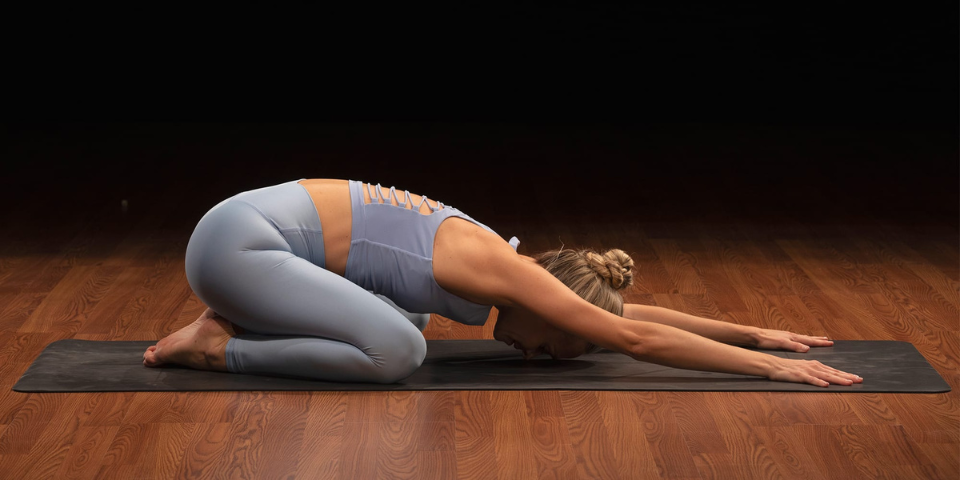
3. Child’s pose (Balasana)
- Start on all fours on the mat. Place your hands directly under your shoulders and your knees under your hips. Bring your big toes together.
- Sink your hips back toward your heels. Rest your stomach between your thighs and your forehead on the mat.
- Stretch your arms out in front of you. You also have the option of stretching your arms back and shrugging your heels.
- Breathe for a few minutes.
4. Cat and Cow Stretch (Bitirasana and Marjaryasana)
Inhale: Cow Pose
- Return to all fours from child’s pose. Keep your back flat, neck long, and gaze directed toward the floor.
- As you inhale, lift your tailbone and chest toward the ceiling and lower your abdomen toward the mat.
- Move your shoulders away from your ears. Squeeze your shoulder blades and lift your head in line with your torso.
- As you exhale, come into cat pose.
Exhale: cat pose
- From Cow Pose, exhale as you round your spine, tuck your tailbone, and bend your chin toward your chest.
- Inhale and assume cow pose.
- Repeat this flow for up to 10 breaths, or more if needed.
5. Sitting forward bend (Paskimottanasana)
- Come to a seated position on your mat.
- Sit with your legs stretched out in front of you and your back straight. Bend your legs. Place your hands beside your body and place them on the ground.
- Keep your knees soft (an option is to put a blanket under your knees).
- Pull your abdominal muscles inward, hinge at your hips and fold over your thighs. Walk your hands from foot to foot. Avoid arching your back or using your arms to pose.
- Continue breathing for at least 5 times. With each exhale, relax, straighten your posture, and stretch deeper. Get up while breathing in.
6. Pose with narrowed corners (baddha konasana)
- Sit on your mat with your sitting bones directly below you (don’t tuck your tailbone in).
- Touch the soles of your feet together. Open your knees wide like a book (you can also slide two blocks under your knees if you have tight knees).
- Slide your heels as close to your crotch as possible for comfort.
- Place your thumb on the ball of your foot. Wrap your remaining fingers around the tops of your toes.
- Sit tall. Look forward and open your chest.
- If you want to deepen the stretch, bend your hips forward without rounding your back.
- Hold for at least 5 times or 1 minute.
7. Happy Baby Pose (Ananda answers)
- Lie down on the mat. Bend your knees and place your feet flat on the mat.
- Hug your knees to your chest. Bring your knees toward your chest and grab the outsides of your feet.
- Pull your knees toward your armpits.
- Press your tailbone into the mat (optional rocking from side to side).
- Take a few deep breaths.
8. Corpse pose (savasana)
- Lie down on the mat.
- Place your arms slightly away from your torso with your palms facing up. Move your shoulders away from your ears and relax.
- Spread your legs apart until your heels touch the corners of the mat.
- Close your eyes, slow your breathing, relax your entire body, and rest for at least 5 minutes.